Showing posts with label Academia. Show all posts

12.21.2015

[Christopher Hyun, ERG PhD student] 

At times it’s difficult to explain the ERG student experience -- even to other grad students at Berkeley. But it’s not so different from other grad students when you think of it in terms of “the Force.”

That's what happens when you don't use the Force in grad school! Or is it? (Kristina Alexanderson)

It’s my first year as an ERG Ph.D. student but my third year as an ERGie, so I’ve already gone through a lot of the initial Ph.D. student anxieties: imposter syndrome, adjusting to working beyond a 9-to-5 schedule, and pretending not to worry about grades since “grades don’t matter in grad school.”

However, when you shift from the Master’s program to the Ph.D., there is a shift from structure and requirements to one of striking it on your own and making your own research decisions. I not only ask myself “What is my research question?” but also “How will I answer it?” and “When?”

It feels somewhat like working on a spaceship, learning all the technical details to fixing the ship from the inside out, and then... untethering. I think I feel like this because there’s a sense that I don’t know enough to figure things out on my own. However, my advisor reassures me that I still have time.

I’m going to geek out here (too late, I’m already in the middle of a Ph.D. program). In my own convoluted way, the relationship between a professor and a Ph.D. student seems somewhat like the Jedi Master-Padawan relationship from Star Wars. In fact, to me, grad school seems like the closest thing in the U.S. we have to a Jedi-like phenomenon.

Getting accepted to a Ph.D. program is equivalent to professors saying, “The Force is strong with you.” Then, you connect with your Jedi Master/advisor. From there, they train you in “the ways of the Force.”

I’m not the only one recognizing the connection. Jorge Cham of PhD comics recently put this out:
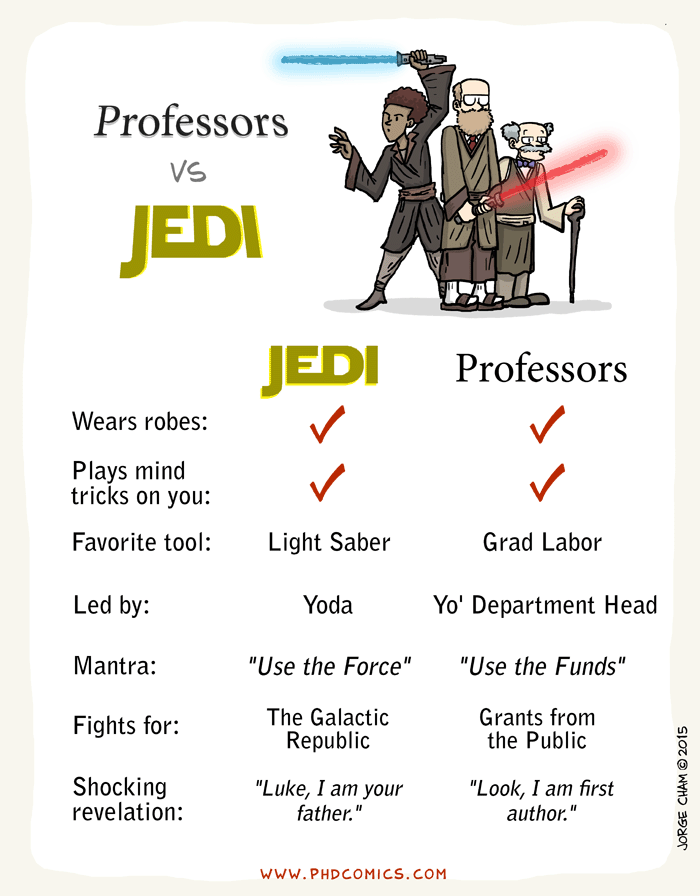

As I consider this further, there are so many more parallels here. I, the Padawan, have been trained in many tools (and at ERG they get pretty diverse): maneuvering through the asteroid belt that is the institutional review board (IRB), extracting information from people on the field through interviews and participant observation, steering the ship of R programming, feeling my way through regression models and principal component analysis (PCA), and reading through applications for the new Jedi Masters of ERG.

There have been more than a few times when my advisors have asked me: “What do your intuitions tell you?” If that’s not Jedi Master talk, then I don’t know what is.

During the Ph.D., one is to go to the edge of what is known and figure out ways to get beyond it. This unclear, fuzzy world of the beyond is our “dark side.” We shouldn’t give in to ignorance and the complacency of not knowing. Into the wee hours of the night we code, make graphs, organize our Mendeley reference files, and take those final readings.

I recently completed my first stab at PCA on data I have been collecting for the past two years. I now have pretty graphs telling me that my intuitions may have been... somewhat off. This is when I think, “Damn it. The Force is NOT strong with me.”

Will I ever become a Jedi Master?

Well, actually, knowing when your analysis gives you a null result is a huge part of understanding the Force -- though academic journals may not readily acknowledge this.

So in a sense, I AM using the Force and overcoming the dark side! I WILL become a Jedi Master! I think.

Now on to a more pressing question: When do I get my lightsaber?

(Image source: JD Hancock)


Note: The views expressed here belong solely to the author of each entry and are not representative of the position of the Energy and Resources Group, UC Berkeley.

10.07.2015

[Daniel Aas, GSPP-ERG graduate student]

The Fall 2015 Newbie cohort at ERG (of which I am a proud member) is 17 strong, 4 of whom are dual Goldman School of Public Policy (GSPP) students. Based on the cohorts above me, and a rough accounting of dual-degree alumni from years past, this represents a new high water mark for combined GSPP/ERGies since a linkage between the two programs was formalized.

The apparent increasing popularity of the dual degree has led me to reflect a bit on why I made the choice to double up in my graduate education.

In deciding to apply to the dual degree, I found it to be relatively straightforward to tell the story of why ERG and GSPP are complementary programs. In my telling, ERG offered the opportunity to gain depth on the energy and resource issues I care about, while GSPP would provide me with the facility to translate substantive depth into actionable policy recommendations. If you’re guessing that most of the previous sentence was cribbed from one of my application essays (or at least an early version of one), you would be absolutely correct. It’s a neat little story, right?

... my misperception [was] that ERG is a place of specialization, while GSPP offers a more general curriculum. In fact, I have come to realize that... quite the opposite is true.
Having spent a year at GSPP and a month as an official ERG student, I’ve started to notice some of the seams in that story. To start, ERG is an academic group, GSPP is a professional school. The difference between those two concepts can best be described with the terminology staff at the school use when referring to students. At GSPP, students are frequently referred to as analysts in training. The implication is that GSPP graduates will be spending our careers working to ensure that public policy is just a bit better informed by evidence-based approaches.

At ERG, the presumption is that many of the students are future academics or, if not, will work in research oriented fields where they expand the boundaries of interdisciplinary energy and resource knowledge. These terminological differences are directly reflected in the courses you take. GSPP courses tend to focus on an ability to leverage others' work to evaluate impacts of policy alternatives, while courses ERGies take often focus on building foundational graduate-level disciplinary skills that might inform a future dissertation. 

The second seam in my story stems from my misperception that ERG is a place of specialization, while GSPP offers a more general curriculum. In fact, I have come to realize that, in certain dimensions of each word, quite the opposite is true. While the subject matter of ERGies’ work tends to fall in a limited number of buckets, students’ approaches vary from environmental science to video game design. Students at GSPP, in contrast, have a wide variety of topical interests, but the school itself emphasizes fairly uniform approaches to policy analysis, mostly focused on economic analysis of allocative efficiency (equity gets mentioned now and then as well).

... my coursework at ERG is not just an opportunity to gain technical depth on energy, but to also gain valuable perspective on the non-economic, interdisciplinary approaches to a wide variety of energy and resource issues.
With these seams in mind, does the story of my application essay fall apart? Despite the preceding two paragraphs, I think the answer is no. Instead, my story has just metamorphosed a bit. Where I once saw GSPP as a source of topical variety, I now see its emphasis on economic efficiency as a grounding criteria to keep in the back of my head as I go up the learning curve on the physical aspects of electric power at ERG. I’ve also come to realize that my coursework at ERG is not just an opportunity to gain technical depth on energy, but to also gain valuable perspective on the non-economic, interdisciplinary approaches to a wide variety of energy and resource issues.

What, if anything, does this recontextualization of the dual degree mean? I have to confess that I don’t know. I suspect that it implies some trade-off between breadth and depth, but as I described above that trade-off isn’t necessarily easily split across departments. Perhaps the trade-off will fall more neatly into those courses that prepare me to be an analyst versus those that develop skills better suited to an academic setting.

What will probably happen, though, is that some new narrative will emerge that ties together my graduate coursework, extracurricular, and work experiences. The only thing I know about that story at the moment is that it is in progress.


Learn more about the MPP-ERG concurrent degree here.

Top image source: Steve Day


Note: The views expressed here belong solely to the author of each entry and are not representative of the position of the Energy and Resources Group, UC Berkeley.

5.06.2015

[Monkgogi Otlhogile, ERG grad student]


Something very strange has been happening to the class of 2016.* In a few months, we will be celebrating our first ERG birthday! A huge growth spurt has occurred overnight for the “babies” of ERG. In a matter of months, I have gone from crawling through Energy and Society’s first problem set to taking full strides (not so confident but strides nonetheless) into my Master’s project. I have noticed that when first-years introduce themselves, we no longer speak of vague research interests but have concrete and specific research goals. Our cohort is now fully integrated into the ERG community, and I have become privy to how my fellow first-years have become resources for the community at large. Our second semester is coming to a close, and I am coming to terms that in a matter of weeks we will no longer be “newbies” at ERG.

... my own transformation at ERG has been so rapid that I didn’t even recognize that I was no longer the jet-lagged newbie nervously introducing myself to my awesome cohort in late August.
I started thinking about my own growth at ERG, when I joined the ERG welcome committee and began interacting with prospective students. I was shocked that prospective students were looking to me for answers, because my own transformation at ERG has been so rapid that I didn’t even recognize that I was no longer the jet-lagged newbie nervously introducing myself to my awesome cohort in late August. I have given lots of thought about what ERG has taught me in the last eight months and realized that ERG’s contribution goes beyond my own intellectual experience but has spread to those around me. I have taught my parents how to do back-of-the envelope calculations over Skype, I told my friends when was the best time to buy gas and I now get a kick out of telling people how many grains of sand are on all the beaches in the world — thanks to John Harte. However, according to those closest to me the most important thing that ERG has given me is an unabashed excitement about my own research and my potential career path.

Joe, Katie and Laney hanging out in "ERG Town" (ERG's recently renovated study space)

...no one person’s intellectual space looks the same at ERG, and the tools given to us could be used in an infinite number of ways.
Being a newbie is not just about not knowing where Wellman Hall is or not knowing that Kay Burns can literally save your life with a couple of key strokes. Being a newbie at ERG is about being given your own intellectual space and tools with which to carve your space into new, pertinent and interesting research. This process is even more daunting then using TeleBears for the first time while in Botswana. In the first months, everyone else’s intellectual space is so impressive that some days at ERG felt like being surrounded by numerous Jimi Hendrixes playing the most beautiful solo when you can barely strum a single cord. However, it was older ERGies who reminded me that no one person’s intellectual space looks the same at ERG, and the tools given to us could be used in an infinite number of ways.  I was encouraged to not look around at what the other cool kids in the classroom were doing but to invest in research that excites me and feeds my intellectual hunger.

ERGies out enjoying the Bay Area

Being a newbie at ERG is about being given your own intellectual space and tools with which to carve your space into new, pertinent and interesting research.
By no means do I have a refined research question (sorry Margaret and Duncan!), but my year at ERG has given me not only new friends, new faculty-related jokes, and new quantitative skills but also a new outlook on my research that has restored my faith in academia and my choice to join this program. Even though I am still in awe of the many incredible researchers at ERG, I know that the enthusiasm I bring to my research will eventually allow me to be one of the cool kids.  In a few weeks our cohort will no longer be newbies, but my hope is that even as we transition into becoming the cool kids, we never forget the “research excitement” we experienced as newbies at ERG.


Top image: Newbies 2014 at the end of their first semester at ERG, having a holiday dinner
* Fall 2014 entering ERG cohort, a.k.a. Newbies 2014.


Note: The views expressed here belong solely to the author of each entry and are not representative of the position of the Energy and Resources Group, UC Berkeley.
 
© ERG. Design adapted from Main-Blogger Blogger Template.