Showing posts with label California. Show all posts

1.19.2016

[Britt Shaw, ERG graduate student]  

ERG grad student, Britt Shaw, explains how she built a graywater system and turned "gray" into "gold."

 
When I first laid eyes on our spacious, but bone-dry backyard, my mind was filled with big ideas – the kind you see in those summer hardware store commercials with smiley DIYers. I dreamt of a garden, and my housemates were also sold on the idea of creating one that we’d sit out and read in, eat from, and enjoy. My only hurdle in this grand effort (other than precious free time) would be water.

Our "bone-dry backyard"


Part 1: The Drought and the Renter

Even with native, drought-resistant plant varietals and efficient drip irrigation, a medium-sized edible and floral garden would require a major increase in water use from our baseline — particularly when considering that our outdoor usage back in August was for about 10 small-potted plants. With the East Bay Municipal Utility District (EBMUD) goal of reducing demand by 20% from 2013 usage and institution of Stage 4 drought surcharges, my first thought was to see where we might cut down our water usage in the home so that we could shift that usage to the garden.

However, I soon found that my housemates were already pretty sparing with water and even saved some graywater from the kitchen in a container to water their potted plants. Then, I ran my first load of laundry at the house… bingo — so much useful graywater being wasted!

We have an older, inefficient washer with a wastewater hose that drains straight into a laundry sink next to it. I would venture that our top-loading washer uses an average of 30 gallons of water per normal size load of laundry through the wash and rinse cycles.

Eyesore or gray gold?! (Author's photo)

Now, you may have the same idea I did: “If the landlord were willing to replace this washer/dryer with more energy- and water-efficient models, we’d save resources and money” (we pay for water as well as gas and electricity).  But, alas, that was not an option for us. So, in lieu of that, I decided to design a graywater system to channel all that wasted water out to the garden without displacing any sheet rock nor otherwise involving my landlord.

A note on El Niño:  Yes, Californians, it’s raining more often this winter (and snowing!), and that is a glorious turn of events.  However, as EBMUD reported, though average precipitation in the utility district was 126% of “normal” as of December 23, the total system storage (EBMUD reservoirs) is still at only 46% of capacity.  Through this wet winter, I won’t likely be using much of our laundry graywater. Those hipster-beloved potted succulents can drown, especially without proper soil drainage, people – move ‘em someplace drier or lose ‘em. When the storm season ends, our little backyard reservoir will become pretty essential again.

Part 2: Build, Own, Operate

There are many designs for super efficient, low user effort graywater systems that are integrated into the plumbing of a building. These require some holes in the wall, plumbing work, plumbing know-how (not in my wheelhouse… yet), a permit from the city of Berkeley, and patching or rebuilding of interior and exterior wall sections. This may be a great option for homeowners but isn’t always an option for renters with little to no income.

My goal was to make the least expensive, least invasive (construction-wise) graywater system possible that would still sustain a small edible garden and drought resistant shrubs, flowers, and ground cover. Conveniently, Berkeley does not require a permit for graywater systems using laundry exhaust water nor other electric pumps. (See“laundry to landscape.”)
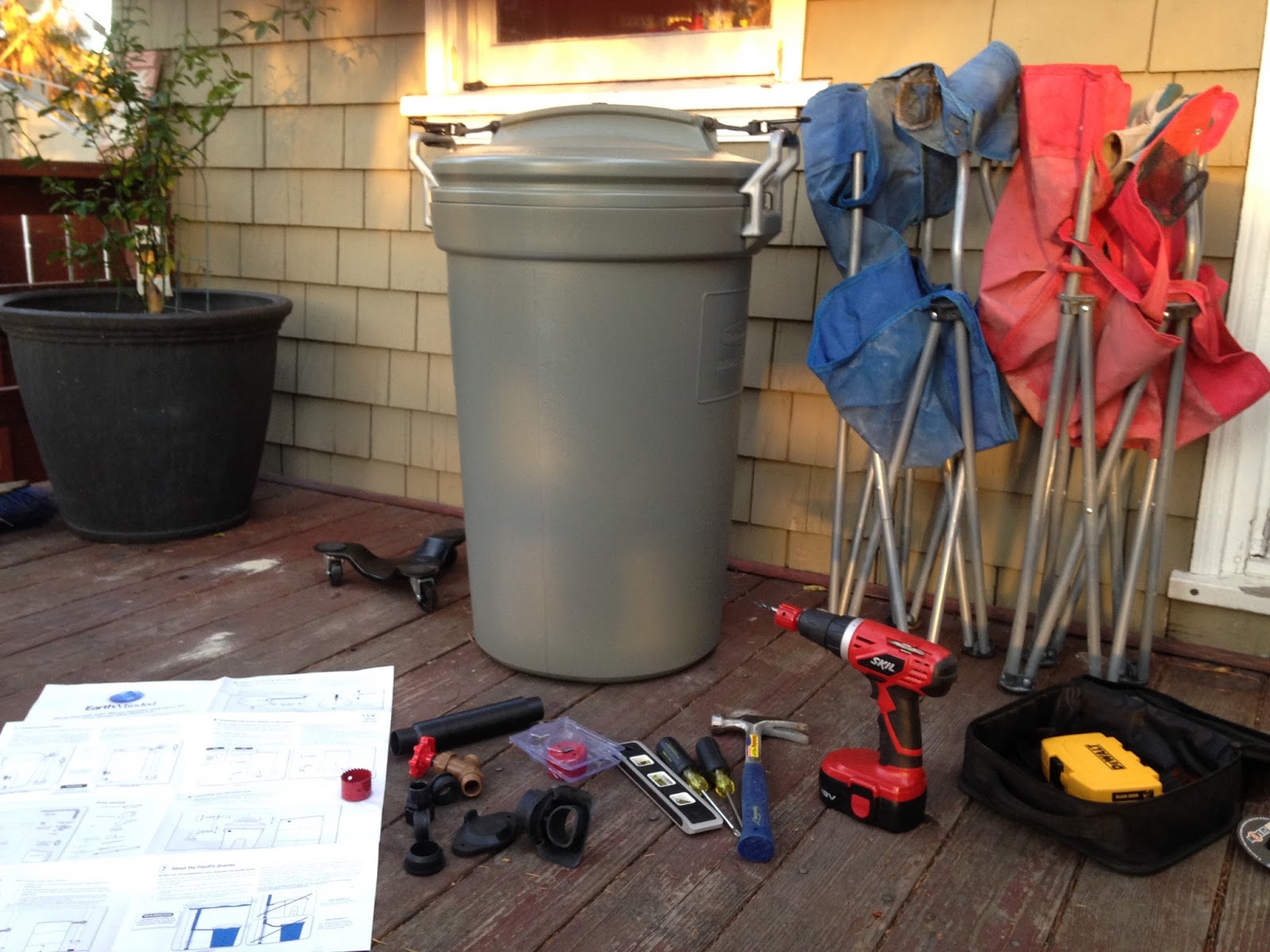
Step 1: Assemble parts for graywater bin – Trash bin, EarthMinded DIY Rain Barrel Diverter and Parts Kit
 
I picked my simple system design based on some web research, a low budget, and advice from a very helpful employee at Orchard Supply (thanks, Willy!).  I bought a 32-gallon animal-proof trash bin (more secure lid) with no wheels, and therefore no holes in the bottom of the bin. This is the cheapest way I found to make a safe storage vessel for the graywater. That is, it’s “safe” as long as it doesn't sit around in the bin in the sun long enough to grow scary bacteria.

I also bought a kit, which included some circular saws for a power drill, a spigot, a rubber stopper, a plastic hose, and a sticker telling me not to drink the water.  You could assemble this kit at a hardware store for way less than the kit’s price tag ($27), but I was lazy and a “noob.”

DIY Rain Barrel Diverter and Parts Kit

I drilled three circular holes into the bin and attached:
  1. a long plastic hose to attach to the washer drain-spout,
  2. a small stopper to let out water at the bottom of the bin when necessary, and
  3. a spigot, sized for a garden hose about a foot from the bottom of the bin 


Step 2: Drill holes and screw in attachments. Ta-da! It’s really that easy.


Now to get the water to the bin without carrying it in buckets, I bought a long (8 foot) plastic hose to connect the washer hose to the trash bin. The washer and wastewater hose is conveniently located next to the window that can be seen just above the bin in the first picture in the “Step 1: assembly” set.  Because I can’t drill through my exterior walls to make this hose connection permanent, I’m going to run the hose through the open window and connect it to the bin only when we are washing clothes. Yes, it certainly does require more effort than the integrated graywater plumbing system shown below, but for those on a tight budget with uninterested landlords, it works!


Example of  an integrated, untreated graywater system for irrigation. (Source: Crook, J. and Rimer, A.E. (2009) “Technical Memorandum on Graywater”, Black and Veatch Technical Report, p. 4.)


To make this design work better for me, I bought a small-wheeled dolly that the bin will sit atop, so that I can roll it from the window to the edge of the back deck where I will attach the drip irrigation lines and water the plants. Because there will be a five foot drop from the spigot to the ground, where I’ll be growing veggies and herbs in planter boxes and non-edible drought-resistant plants, there should be enough downward gravitational force to draw the water from the bin to the plants without any additional energy input. (This is perhaps a good back-of-the-envelope problem for another time.)

Drip irrigation systems are more efficient than watering plants with a regular garden hose. Tiny spigots along the plastic drip irrigation hosing feed water more slowly down to the roots of a plant. This is opposed to spreading water thinly across exposed soil and leaves only to have a large proportion evaporate before reaching the roots. You can also purchase timers to turn on water at specific times of the day (before 9am or after 6pm, for example), or while you are away from the home.  I haven’t yet built my planter boxes, so the drip set-up is still under construction, but I’ll be using the remaining winter months to prep the soil and planters for early spring sowing.

Part 3: Is it safe?

Common sense and the sticker on my graywater bin tell me that I probably shouldn’t drink this water. But, can I eat what it helps me grow?  My goal in this project was not only to create a cheap graywater system that would produce enough water for my garden, but also one that would yield safe water for my edible plants.  There were three potential problems I foresaw with our laundry graywater:
  1. chemicals from laundry soap that might be harmful
  2. high alkalinity (because soap is typically alkaline or basic)
  3. clothing fibers, especially synthetics

The issue of chemicals was a relatively easy problem to begin tackling. I already use graywater-safe laundry detergent and my housemates are willing to switch brands, which cuts out many of the non-natural cleaning chemicals that would concern me. Still, I read up a little more on my detergent’s ingredient list (see below) and found some information on the natural surfactants (or dirt-lifters) derived from coconuts and other “natural” sources. While these plant-derived surfactants are more environmentally friendly than the commonly used surfactants, i.e. sodium dodecyl sulfate (SDS) and sodium lauryl sulfate (SLS), the key ingredient listed on my detergent, “Plant Based Surfactants (Coconut),” is pretty darn vague.

Companies aren’t currently required to explain the composition of these surfactants on the label. Without more information on which chemicals make up the surfactant, it’s hard to know whether it is safe to put on the plants and indirectly ingest.  That said, I’m pushing forward knowing that my body is already taking in whatever is in my soap through my skin. If you are interested in graywater safe cleaning products, check out the Ecology Center’s page on the subject here.


Trader Joe's Biodegradable Laundry Soap ingredients label. Several of the ingredients are vaguely defined (surfactants, fabric softener, and optical brightener). I plan to research further whether this will have an impact on my food quality.  (Author’s photo)

As for graywater acidity/alkalinity, I anticipated that my graywater, which contains soap and clothing fibers, would be basic on the pH scale (i.e. greater than 7.0). In addition, our machine spits out water in three different bursts: post-wash cycle, post-rinse cycle, and post spin cycle.  By doing a little experiment with the graywater, I thought I might be able to determine if I should only be reserving water for the plants from one or two of the laundry cycles instead of all wash wastewater. I decided to take separate samples from each of these three water output cycles and test them for pH and total dissolved solids (TDS).
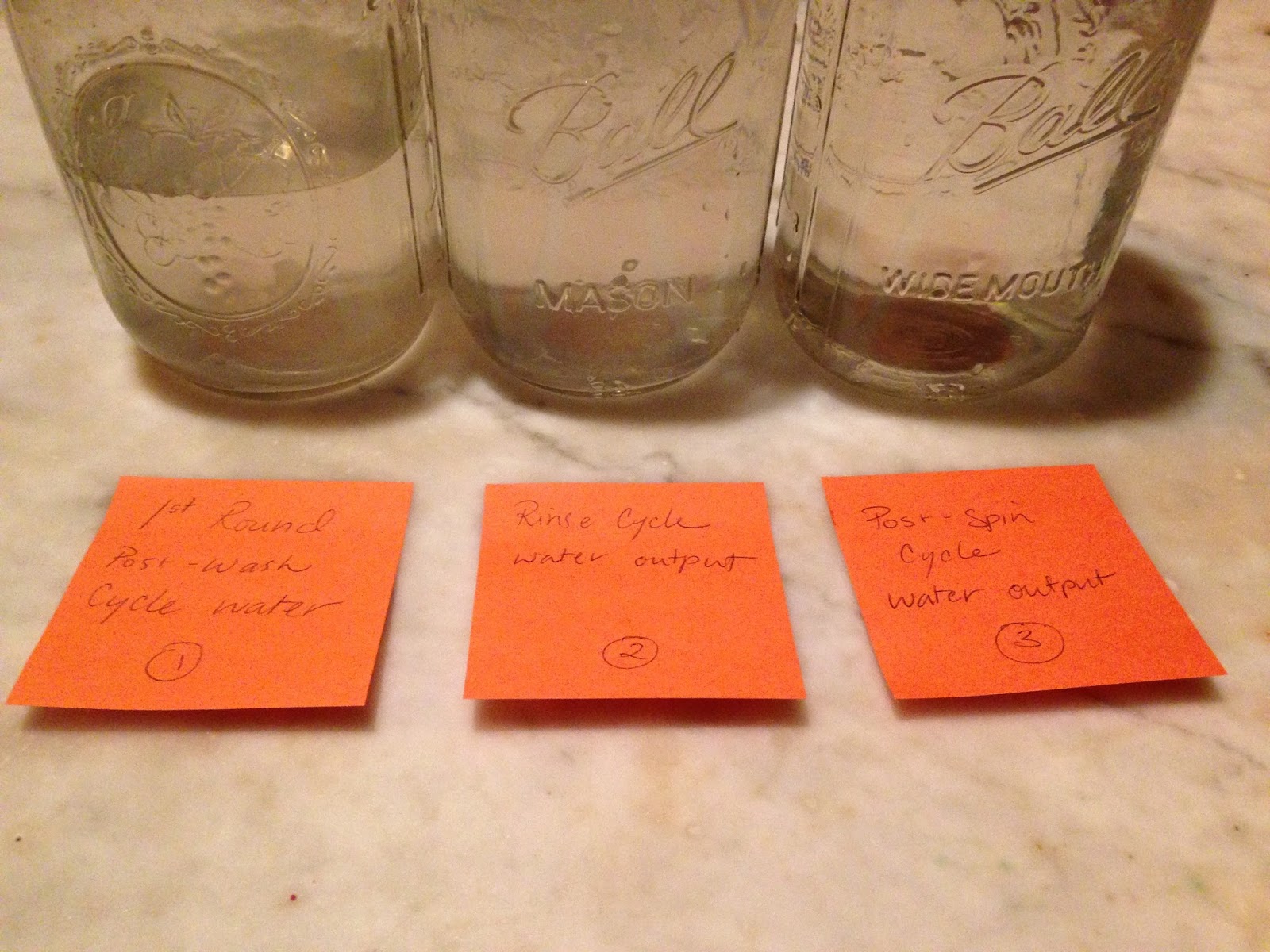
Three water samples from the laundry cycles in covered containers (Author’s photo)
 
My chemistry knowledge was very rusty for this endeavor, so I had forgotten that a TDS meter measures the amount of ions in a solution, including salts, minerals and metals in parts per million (ppm). Thanks to Chris Hyun for clearing things up for me! I would have liked to measure the amount of clothing fibers and other solids in the graywater, which would have been Total Suspended Solids (TSS), but unfortunately was not able to access the equipment to test for TSS.

Given that, I’ll just mention that clothing fibers and various solids from my dirty laundry will end up in the soil. I anticipate that most will settle at the bottom of the barrel, making it easy to clear them out periodically, but it may be prudent for me to add a mesh cloth over the entry to the spigot to filter out larger particles from the solution before it enters my narrow drip hosing.

I was lucky enough to have one of my housemates test the pH of the samples in her climate controlled molecular biology lab with fancier equipment on campus, so I’m fairly confident about those values.  My hypothesis was that the post-wash cycle would yield the most alkaline liquid (thinking that more soap would come out after the wash cycle than the rinse and spin cycles). I also hypothesized that the post-spin cycle liquid would have the highest TDS content.


This is what my digital TDS meter looks like - it is accurate to 3 significant figures and was rinsed with lab grade distilled water between readings. (Author’s photo)


Results:
Cycle type in order
pH
TDS (parts per million)
Post-Wash Cycle
6.60
38.3
Post-Rinse Cycle
6.78
36.8
Post-Spin Cycle
7.07
36.1

I was delighted to find that the pH levels of my graywater would be safe to use on the plants, and that they won’t likely have a large impact on the soil pH for the roots.

Contrary to my hypothesis, the pH values for the samples were in fact slightly acidic until the spin cycle.  Another lazy science admission: I hadn’t measured the pH of my tap water to see what the acidity of the effluent would be without soap and soiled clothing (ugh, silly me!). It’s highly unlikely that the city water entering my washer is perfectly neutral, so that could have been a factor. In addition, I think the post-wash and post-rinse cycles may have been slightly acidic because sweat and some other human body fluids tend to be acidic (see here for an interesting study on pH changes in thermal induced sweat versus hormonal induced sweat).

As I found in my quick research on optimal soil pH for various plants, the edible plants I’ll grow (tomatoes, green beans and lettuce, to name a few) “prefer” soil pH levels in the range of 5.5-7.0.  I can adjust the soil pH if needed by adding rock powders, sulfur or limestone, but am hoping I won’t need to.

The TDS readings were also a relief to see, since they translate to about 37 milligrams of dissolved solids per kilogram of water. This means that there is a low number of ions in the solution (including salts and minerals from the soap and soiled clothing), and I anticipate that they will have negligible effects on the soil.

From this little experiment, I have concluded that it will be reasonably safe to use the wastewater from the entire wash process in my plants.

In the spring, I hope to follow this up with a check in on how the plants have fared with graywater (which I’ll gauge by having a control area watered with potable city drinking water and rainwater).  I also hope to find a way to run tests on any toxins that may be in my homegrown vegetables, perhaps at the College of Natural Resources’ Oxford Tract. Stay tuned!

5.14.2015

[Laney Siegner, ERG graduate student]

“Only in the past decade has farm to school emerged as a movement to change the way children understand food and to offer farmers new markets for what they produce.” (Beery & Joshi, 2012) 

Tasting reception at Monterrey High School featuring food produced by participating districts in the California Thursdays initiative.

At the Asilomar Conference Grounds, there was a palpable excitement for those present of being in rooms full of farm to school enthusiasts. Although hailing from a variety of backgrounds and job titles (teachers, farmers, school administrators, food service directors, school “chefs,” non-profit leaders, school board members, parent volunteers, and academic researchers), all were enthusiastic about the premise of providing real, healthy food to schools from local farms.

The Farm to School program in California currently involves over 85 school districts, of which Berkeley Unified School District was the first district in the country to pass a progressive food policy recognizing the connection between healthy eating and effective learning. On May 4-6, 2015, over 250 California “first responders” to the national health care crisis convened in Pacific Grove, CA for a state-level Farm to School conference.

Conference attendees were encouraged to take a "holistic view" of how fresh produce contributes to school curriculum and education. Laney is the corn with the tennis racket on the left.

Sam Farr, Democratic Congressman from California, delivered opening remarks asserting that the crew gathered before him were first responders in the sense that providing healthy food grown on local farms to students in school was a fundamental strategy for reducing childhood obesity and the associated lifetime health care costs that put such a strain on the national system. From an ERGie perspective, I am used to hearing such interdisciplinary analyses of the benefits of a particular program like Farm to School. This was just the first in a series of frames placed around Farm to School programs, from health and nutrition to environmentalism, to climate change, and improved math and science education.

... it is important to note a central theme of the conference: the need to more rigorously evaluate programs consistently across districts and states...
This basic idea of farm to school has become “revolutionary” thanks to the modern industrial food system, a huge source of greenhouse gas emissions (due to transportation, concentrated animal waste streams, land use change, and chemical fertilizer inputs) environmental degradation and adverse human health outcomes. Not to mention the loss of aspects of culture associated with the loss of small farms and farmers as a way of life in this country. Issues of food are issues of culture: food is what we are and want to be. If we want to be diverse, full of variety, connected, healthy, and environmentally “literate,” than our food system has to be those things first.

As a means to promote biodiversity, local economic development, social justice, secondary education, and environmental and human health, school gardens or farm-to-school programs are pretty compelling solutions to contemplate. They hit so many targets with one arrow. However, before getting too carried away with the idea, it is important to note a central theme of the conference: the need to more rigorously evaluate programs consistently across districts and states; the need to collect numerical data year after year, and the need to move beyond anecdotal “success stories” towards scientifically driven empirical results necessary to secure sustainable funding for such programs.

CA Thursdays is an initiative started by the Center for Ecoliteracy in Berkeley. 

It is my hope, as a researcher and former educator, that Farm-to-School can be embedded as part of a holistic approach to secondary school reform. According to the “3 pillars” of the U.S. Green Ribbon School award program, schools must meet building, operations, and curriculum standards in greening their school. To meet these criteria, for example, cafeteria food might be procured from local farms and supplemented by an on-site garden-classroom; the school implements energy efficiency and waste recycling/reduction measures in buildings; and the curriculum across subjects is reflective of the realities of climate change and today’s environmental problems,

To see what some schools have been on to with Farm to School programs, conference participants were invited to Monterey High School for a “California Thursdays” tasting reception of what local school districts are offering to their students. The California Thursdays initiative was created by the Center for Ecoliteracy and piloted in Oakland Unified School District; currently 42 districts participate in serving meals sourced from California ingredients on that day of the week (totaling over 250 million meals annually).

The results were impressive, colorful, and delicious; a promising sign of things to come in building the world we want the next generation to inherit. For more info on CA Farm to School programs, policy initiatives, and resources for schools, go to http://www.farmtoschool.org/our-network/California.


Note: The views expressed here belong solely to the author of each entry and are not representative of the position of the Energy and Resources Group, UC Berkeley.

4.16.2015

[Rachel Golden, ERG graduate student]


My alarm goes off at 4:30 on Saturday morning in a hotel room in Chowchilla, a small city (under 20,000) in the San Joaquin Valley, that feels like a deserted rural town. Unsure if I have slept at all, I slip quietly out of the hotel and slowly drive through a thick darkness. Silently freaking out and cursing Siri, I drive for 20 minutes in the wrong direction on the I-99. My counterparts later teased me that “you city folk don’t know how to drive in the Valley.”  It’s true, I’ve gotten lost twice in 24 hours.

Once I reorient and backtrack, I begin to see cars lined up like a silent train along the side of the road, about a mile from the Chowchilla fairground. The fairground parking lot is where Valley Clean Air Now (ValleyCAN) will be hosting the “Tune In and Tune Up” event in a few hours.  Hundreds of people spent Friday night in their cars alone, with loyal friends, or with their families to get a place near the front of the line. Several people even arrived at noon the day before in order to ensure entrance to the event. The lined-up cars are old. Really old. Most are “pre-OBDIIs,” (made before 1996) and are classified as some of the most polluting cars on California’s roadways.  It is said that cars are born in California’s coastal cities (like the Bay Area) and come to die in the Central Valley. Only, they don’t die. These cars clunk around for well beyond their expected lifespan on expensive life-support, because people have few options for transportation and depend on these wheels for groceries, work, and taking kids to school.

Jose in the early morning directing cars into the parking lot from where they were parked (and slept in) overnight

The people in line aren’t sleeping in their cars to get Taylor Swift tickets. Or a selfie with Barak Obama. They are there for a free smog screening and a $500 voucher to get the needed car repairs for passing the smog test—a prerequisite in California for keeping your car registered. Wait, this is a story about SMOG TESTS? No! Okay, yes. Well, sort of. It’s really a story about much more. This is a story about community groups coming together from all parts of life to make living a bit easier and healthier.

Some quick stats to set the context:
  • Smog (i.e. ground level ozone), which is just one of the forms of air pollution caused by cars, can cause asthma, hurt the linings of lungs, aggravate chronic lung diseases such as emphysema and bronchitis, and reduce the immune system’s ability to fight off bacterial infections in the respiratory system.
  • The San Joaquin Valley is home to the worst air quality in the country and has some of the highest rates of childhood asthma in California.
  • Those most impacted by smog are children, adults who exercise or engage in outdoor physical labor (think agricultural and construction workers), and those with continued exposure (think everyone who lives in the Valley).
  • Smog’s not all. These nearly 2-decade old cars also produce considerable hazardous air pollution, contributing to increased risk of cancer, heart and lung diseases, and diabetes.
I pull up to the fairground gates at 5:45am to see Tom Knox standing in the dark wearing his white ValleyCAN t-shirt and holding a bottomless cup of black coffee. Tom seems to be in a long-term relationship with caffeine, and this event, “Tune In and Tune Up,” is their baby. Tom is the executive director of ValleyCAN and has generously met with me weekly for my research. I spend the next hour discussing the day’s logistics with him and the event manager Jose Martin, a community organizer from outside of Guadalajara, Mexico. Jose tirelessly travels up and down the Valley, building support from community groups for these events, which occur every other weekend as far north as San Joaquin County and as far south as Kern County.

At 6:30am the sun starts to rise and Jose opens the gates to the fairground parking lot. We see the silent train come to life as over 500 cars turn on their engines one by one and roll into the lot, which is lined with orange cones and tents staffed by people in orange vests. Many of the cars are without license plates, about half are unregistered, yet most people are smiling because they are a few feet closer to getting that voucher to clean up their cars. 


Lideres Campesinas, the women who cook lunch for all participants and provide community education for farmworkers about sexual assault and abuse

To a bird in the sky, this event just looks like a parking lot. But on the ground, there is more than meets the eye. The traffic is directed and the event managed by local community groups, like gang prevention groups, who get a modest payment and work experience. The cars are screened by local, top smog testers and students from community colleges across the Valley. In school, the students only see one car a day, but out here they see up to 550 in a day. The students soon become experts, able to open up their own local smog test shops and return here as teachers. Women from the group Lideres Campesinas get paid to cook a free lunch for all participants and set up their table of educational flyers for agricultural workers about sexual assault and violence. Three radio stations set up their tents to blast music and broadcast live from the fairground parking lot to cover the event.


Veronica, who manages a pilot program funded by the San Joaquin Valley Air District that gives qualifying low-income Valley residents up to $5,000 to retire their old car and purchase and lease a new cleaner model

And in a small tent off to the side sits Veronica, who manages a pilot program funded by the San Joaquin Valley Air District that gives qualifying low-income Valley residents up to $5,000 to retire their old car and purchase and lease a new cleaner model. Paired with California’s Clean Vehicle Rebate Program, low-income drivers can get up to $12,000 to purchase or lease an advanced car like a plug-in hybrid electric vehicle (PHEVs). Since there are no PHEVs in dealerships in the Central Valley and inadequate chargers to keep these cars moving, most drivers opt for a smaller rebate for a less advanced vehicle, like a used minivan or occasionally maybe even an early-model Prius.

I can’t help wondering if some Berkeley environmentalists’ eyes are rolling. Cars are evil. Why aren’t they getting electric vehicles? What about public transit? We shouldn’t even be farming in the Valley anyway.

Yes, I know. Maybe I’m just sleep deprived, but the way I see it:  People live here, in the Valley. For their livelihood they need to drive long distances.

  • Until we can make major system-wide changes so we can live in balance with the natural environment…
  • Until state regulators (CPUC and CEC), utilities, and industry groups get EV charging stations installed at scale…
  • Until the California Air Resources Board deploys hundreds of millions of dollars of cap-and-trade revenue to counties and community groups to increase low-income people’s access to EV cars, buses, and trucks…
Until any of this happens, simply retiring the oldest fleet and getting people into cleaner cars is the best game in town.

Until any of this happens, simply retiring the oldest fleet and getting people into cleaner cars is the best game in town.

Although it may make many environmentalists queasy, getting cars built in 1995 and earlier off the road for good, and replacing them with LEVIIs (cars made since 2008) will bring considerable air quality benefits to the Valley (i.e. reduced NOx, SOx, smog, particulate matter), improve fuel efficiency, and ease the financial burden for low-income people who are car dependent. This is just one first step in a longer-term game plan towards turning over the fleet and making way for near-zero emission vehicles.

In the meantime while the low carbon solution is being simmered and seasoned in state agencies and prodded by green groups, an under-the-radar smog event — which under most circumstances sounds like the last place to spend a Saturday afternoon — actually feels like a community party with music trumpeting, free food sizzling on the grill, and a team of unlikely partners bonding over a job well done.


Note: The views expressed here belong solely to the author of each entry and are not representative of the position of the Energy and Resources Group, UC Berkeley.

8.07.2014

[by Nkiruka Avila, EDFCC Fellow at PerkinElmer & ERG Graduate Student]  

EDF engagement manager Serena Mau and EDF Climate Corps fellow Nkiruka Avila during a tour of the PerkinElmer Fab.
Energy efficiency is an essential part of climate change mitigation, which is my primary motivation for becoming an Environmental Defense Fund Climate Corps fellow. My goal is to find energy and water savings at my host organization PerkinElmer in Santa Clara, California. PerkinElmer designs and manufactures medical imaging technology that tackles the world’s most critical health related challenges.

The facility I am working in this summer has a class 100 clean room (we call it “the Fab”) where 50x50 cm digital flat panel x-ray detectors are fabricated. Any impurity in the Fab could cause defects in the panels. PerkinElmer’s fabrication process is unique because each of the panels produced is kept as a whole unit and is not cut into smaller pieces. This makes it critical to produce flawless panels every time as a defect could ruin the whole panel.

Recently, I took a tour of the Fab with my supervisor Joe Batdorf and my EDF engagement manager Serena Mau. The tour of the Fab was fascinating and revealed just how energy intensive the fabrication process is. I was impressed to see that several energy efficiency projects, headed by my supervisor, had already been implemented at the facility. Energy efficiency is not a foreign idea to PerkinElmer and they have invested in several energy saving measures over the years.  For example, PerkinElmer completed a reheat coil optimization project and replaced two inefficient boilers with efficient condensing boilers saving almost 70,000 therms of natural gas annually and eliminating over 300 tons of carbon emissions.

Despite the implementation of several energy efficiency measures, there is still room for more. I am working on proposing further energy efficient lighting, computer power management software and other energy saving measures for the air compressors and fume scrubbers in the facility. Silicon Valley Power offers great resources like lighting audits to help identify potential rebates. I am also investigating water conservation measures for a reverse osmosis system and two fume scrubbers that have the potential to save three million gallons of water annually. With California’s drought, these water conservation measures are direly needed.

Being an EDF Climate Corps fellow has given me the opportunity to learn about energy efficiency solutions and their financial and political obstacles. I am learning about the many incentives offered by the state and local governments in California to promote energy sustainability. EDF Climate Corps has also opened up to me a vast network of professionals and students working towards a more sustainable future. The experience is invaluable and substantiates my intuition that my work is headed in the right direction.

Crosspost from EDF Climate Corps.


Note: The views expressed here belong solely to the author of each entry and are not representative of the position of the Energy and Resources Group, UC Berkeley.

4.15.2014

http://droughtmonitor.unl.edu/Home/StateDroughtMonitor.aspx?CA


[by Zubair Dar] 

If there is one challenge that California would have wanted to avoid facing this decade, it is the drought.
Having taken upon itself the leadership role in carbon emission reduction through clean energy development, the state would rather invest its energy in fulfilling the 2020 and 2030 targets than worrying about its water security. It is not to say that the state was unaware if its water availability, and management practices are not being intensified, but little can be guaranteed about their effectiveness after the worst drought in the recorded history has hit California. The bad news is that the drought is here to stay.

Despite recent rains, precipitation in 2013 and 2014 (so far) is nowhere close to the annual average. Lack of sufficient water is putting the $45 billion agriculture sector that produces a third of all vegetables and two thirds of all nuts in the United States at risk. Experts predict inflation, loss of income and related distress as a few of the impacts on the residents of California. Coupled with the fact that no guarantees can be made about future water availability either, California has to instigate a water management revolution along with the energy revolution it has set off.

What would a water management revolution mean in practice?
As Prof. Lynn Ingram at University of California Berkeley will tell you, that the precipitation of the past 150 years in California has been a ‘wet anomaly’ in California’s deeper history of aridity. And it is in the last 100 years that California framed its water policy, developed its water infrastructure and through legislative instruments distributed water rights. Allocations to agriculture and other industries shaped according to these known patterns of precipitation. In this new phase of aridity, which climate-scientists predict can be worsened by the climate change-induced variability, California needs to rework the whole system. While the impact of the drought might not be homogenous, there is little chance that any sector of the economy can ignore any measure of efficiency.

With few precedents, however, the challenge becomes even tougher. But that is where the opportunity lies. The crossroad where California today stands with respect to its climate history has taken away any uncertainty about the impact climate disruption could have on consumptive and non-consumptive uses of water. And as many thought leaders have suggested, California can take a queue from its energy policy to implement same practices of efficiency and renewability for the most efficient use of its water resources. No doubt the task shall mean a major shift in infrastructure development, irrigation practices, domestic use and industrial water allocations. The state shall need to employ best available technology in combination with most innovative ideas laid out by thought leaders in water management. Yet, the opportunity cost will not outweigh the gains of the new age integrated water management practice.

Past droughts are generally seen to have set off policy rethink as well as technological innovations. The current drought will also trigger innovations and, at the same time, speed up the adaption of the technologies built over the past few years. Already, a range of public dialogues and policy revaluations are underway in the state to find the beat way forward and create a synergy between research, policy and practice of water management.

This year, the Resources Roundtable by Berkeley Energy and Resources Collaborative (BERC) brings together thought leaders, climate scientists, water managers, rights activists and businesses to engage in focused discussions on the topic “California in Drought: Challenges and Opportunities”. As the subtitle puts it, we aim to understand how responding to water crisis today will help develop resilience for tomorrow. It is a unique opportunity for students to understand where the frontiers of water research in California lie.


2.24.2014

By Jess Reilly

Thanks to the recent dedication of the Ivanpah Solar Electric Generating System (ISEGS), the corresponding scathing article in the Wall Street Journal, and Dan Kammen and Tonio Buonassisi’s appearance on NPR’s On Point, Ivanpah and solar energy in general has been back in the news.

Tortoise at Ivanpah (J. Reilly)
ISEGS is a concentrating solar plant (CSP) driven by technology from BrightSource Energy: it uses mirrors to reflect the sun’s light to the top of tower, where the heat turns water to steam. This steam then turns a turbine and generates electricity. CSP has the added benefit of heating a salt medium that can store the heat with minimal losses. Therefore, the plant can provide electricity to the grid not only during the day when the sun is shining, but at night as well. This storage reduces the intermittency of the CSP energy supply and allows the plant to compete with other ‘baseload’ energy supplies like coal and natural gas.

ISEGS happens to be the largest example of concentrating solar in the world, with 360,000 garage-door-sized mirrors and three giant towers sprawled over 5 square miles of Mojave desert. It generates electricity just north of Interstate 5 at the Nevada-California line and transmits to southern California.

Burrow excavation at Ivanpah (J. Reilly)
I walked nearly every inch of those five miles when I worked as a biologist at ISEGS. I was there from the moment the first bulldozer broke ground in the Ivanpah Valley in 2010, under the regal summit of Clark Mountain, until I came to ERG as a graduate student in the fall of 2012.

Ivanpah (J. Reilly)
I returned to graduate school in large part because I could not stand to supervise the destruction of the desert anymore. Having lived and worked in this fragile and biologically diverse desert since 2001, I watched my backyard plowed under for energy that would feed the demand of 140,000 homes hundreds of miles to the west. It did not seem environmentally or socially equitable. After living and working in the Ivanpah valley for two years, I promised this valley I would not let it be further destroyed, and I went back to school to figure out how to protect it.

Here’s what I have discovered:

Solar power protects Ivanpah Valley.

Horned lizard at Ivanpah (J. Reilly)
This is not to say that Ivanpah got it right. I was witness to painful foibles throughout the process as it stumbled forward. It has been a learning experience for everyone involved, from federal agencies to technology innovators.

Yet the very plant that displaced hundreds of tortoises may be the very thing that will save these individuals, their species, and ours.

An energy system built with renewables is necessary if the Mojave desert ecosystem, including the desert tortoise and all its migratory birds, are to survive into the coming generations. Previously, I did not fully understand the implications of a grid that continues to rely on fossil fuels.  But at 400 ppm of heat-trapping carbon dioxide and rising, many habitats and backyards are changing. Global sea level rise is now almost 7 inches higher than pre-industrial times, with the rate of increase today nearly double that of the last century. The extent and thickness of sea ice has dropped dramatically. Glaciers are retreating, and cities that rely on their consistent water supply are looking into a near future where they have no water for their millions of inhabitants.

Kangaroo rat at Ivanpah (J. Reilly)
Therefore, utility-scale CSP is an effective way to bring renewable energy online right now, in tandem with rooftop photovoltaic solar and other renewable technology. In addition, stumbles at Ivanpah have provided the agencies and the industry with the experience for doing things better in the future, and a paper that thoroughly details these possibilities can be found here. In addition to wildlife impacts, solar energy can consume water resources, increase particulate matter in air, and have an unknown impact on soil carbon (sequestration of carbon in soil and rock.)  Yet even this article addresses the cobenefits that the BLM and companies such as BrightSource have learned:

  • we can use degraded land and avoid pristine habitat
  • we can co-locate energy with agriculture and other renewable technology
  • we can carefully address siting with each individual project with thorough consideration given to local environmental, cultural, and social impacts

Dust winds at Ivanpah (J. Reilly)
I am the person who picked up dead lizards, mice, or birds at Ivanpah. I am the person who dug up the tortoise burrows and removed them from their homes. I cried many mornings on my way to work. But I am also the person who, along with the men driving the bulldozers and road blades, stopped equipment to catch and remove lizards, mice, and rattlesnakes. And now, I am a person fighting to preserve the habitat not only in my backyard in the desert, but in rainforests and coral reefs as well, because climate change is insidious: it is often only with extreme events that we are able to take note of changes.

In a sense, I have broadened my backyard: it now includes Los Angeles, the Philippines, and Beijing. And it is only by protecting the environment and fighting climate change in these places that we can hope to preserve a future for the desert tortoise and the peregrine falcon in my desert home.

The views expressed here belong solely to the author of this entry and are not representative of the position of the Energy and Resources Group, UC Berkeley.

12.09.2013

Op-ed by Dan Kammen
Published in Daily Californian

Today, UC Berkeley and most institutions are financially invested in destroying our future.

This may sound a little bit surprising to some — even unfounded. Let me explain. When it comes to climate change, the scientific community has presented a clear, unambiguous message: Human burning of fossil fuels — coal, oil and natural gas — is putting our world at risk.

And this, in fact, is a needless risk. By immediately reducing greenhouse gas emissions, we can reduce the damages that we are currently on the path to creating. Typhoon Haiyan, Hurricane Sandy, Hurricane Katrina and many of the costly recent fires and droughts around the world have been exacerbated — caused, to one degree or another, by the changes in the climate that our reliance on fossil fuels has caused.

Credit: Graham Haught, Daily Californian.

Though UC Berkeley and the UC system are leaders in addressing the climate crisis through groundbreaking research and education, the companies they have invested in continue to leave a significant “carbon signature” on the environment. Many of these investments were made before the full impact of these choices on the climate was clear. Continuing the financial investment in companies like Exxon, Chevron and ConocoPhillips — even though some of these companies have made a start in greening their portfolio — sends the wrong message. These companies, and many more, have the capacity and the opportunity to evolve from stalwarts of the old energy order that must change, into supporters of a new clean-energy system that California and the world desperately need.

The 200 largest fossil fuel companies hold, in the form of projects and assets, about five times the amount of carbon in their reserves that the scientific community has deemed responsible to even consider burning in order to avert runaway climate change. The several thousand researchers on the Intergovernmental Panel for Climate Change have determined with greater than 95 percent certainty that human activity is currently causing climate change. Researchers from across the entire UC system and our state government are critical leaders in efforts to advance both climate science and climate solutions, as well as the adaptation side of the equation.

The overwhelming majority of major energy companies, however, has shown far too few signs of transitioning to low-carbon projects. The fossil fuel industry collectively spends more than $600 billion per year exploring for new hydrocarbons and, in some cases, very significant amounts of money on climate denial, lobbying Congress to maintain fossil fuel subsidies and other efforts that work against the needed and feasible clean-energy transition. These companies are publicly traded and investor-owned, supported in large part by institutional investors like UC Berkeley and the University of California.

Instead of funding the problem, we should be investing in solutions that at once aid the transition to a low-carbon economy and grow our university’s bottom line. There is no lack of financially and environmentally sustainable reinvestment opportunities; as of yet, there is only a lack of leadership.

UC Berkeley has played a vital role as a leader in financial and social accountability. When other institutions refused, the campus listened to its students and the international calls for divestment from companies tied to grave social harm and injustice. As was similarly expressed during the South Africa, Sudan and tobacco divestment campaigns, students at UC Berkeley believe that their campus’s investments should reflect its values of social responsibility and environmental sustainability.

In the case of fossil fuel investments, divesting is not only the moral thing to do but is also financially prudent. As fossil fuel companies continue expanding their search for more hydrocarbons, the world’s carbon budget is shrinking. From Canadian tar sands to shale oil, the ”bottom of the barrel” is proving to be increasingly dirty. When government regulation aligns with this reality — and it must — the vast majority of reserves will have to stay in the ground unburned, rendering them stranded assets. Remaining invested in fossil fuels is a bad bet all around.

With a new chancellor at UC Berkeley and a new UC president, both of whom are leaders in clean energy and climate protection, divestment at UC Berkeley and across the UC system will send a resounding message that the university takes all facets of its leadership position seriously. It will also encourage other institutions to do the same and build pressure for regional and global climate action.

As a faculty member who understands deeply the challenge climate change poses and the urgency with which action must be taken, I call on my fellow faculty to stand with the students of Fossil Free Cal and Fossil Free UC in calling on Chancellor Dirks, President Napolitano and the president of the Berkeley Foundation to be on the right side of history by moving our endowments away from fossil fuels and reinvesting in a sustainable future. Visit fossilfreecal.org and sign on if you are as concerned as I am.

The views expressed here belong solely to the author of this entry and are not representative of the position of the Energy and Resources Group, UC Berkeley.

8.09.2013


By Peter Alstone

This is a short story about riding bikes with kids, and more specifically about the challenges of making good transportation decisions as a parent.

Being a professional energy geek makes me acutely aware of the resource implications of personal choices, and one of the most important is how you decide to travel around town.  Over half the greenhouse gas emissions in Berkeley are from cars and trucks.  We all want to do the right thing and for me this means riding bikes and buses as much as possible.  But what happens when you have a kid who needs to travel with you?

As a parent of a preschooler and an infant, I can attest that first of all, my car gets a lot more use than it otherwise would.  When we need to make a quick trip somewhere beyond walking distance as a family the car is really the only way to go.  The bus can work sometimes but it takes longer in almost every case, and time is a very precious commodity for any graduate student, and particularly parents.  It turns out little kids can be impatient too...imagine that. 

Luckily, having a good bike setup can really help us get back on two wheels.  We use a trailer to haul around our son (the preschooler).  As a bonus, the trailer is a trunk for grocery runs and provides great resistance training.  I tend to agree with people who think trailers are good from a safety perspective too (at least compared to seats on the back of bikes).  That said, it is sometimes harrowing to dive into rush hour traffic with my kid in tow.  The bus is better this way (or back to the car). 

A hipster station wagon

Soon though, our son will be too big for the trailer and not big enough to keep up (or watch out for traffic).  As the late cycling luminary Sheldon Brown describes it, an awkward phase for family biking.  Maybe we'll try a follow-along type contraption. 

Why go through all this headache?  The fun answer is that riding bikes and buses is a much more fulfilling way to get around town than a car and my kids like it to boot.  We stop to check things out on the side of the road (like construction equipment) and take new routes to our destinations when it strikes us.  Parking is never a problem.  When we ride the bus or BART (public train), it is an opportunity to sit and talk about whatever is going on without worrying about traffic and speed limits.  Plus, our son has an ongoing obsession with the different varieties of buses and enjoys pointing out the subtle differences between them (his categories: "New" Gillig Buses, Hydrogen buses, "long" buses—those with a bend in the middle, "line" buses—the old style that have lines painted on the sides, and "normal" buses—the most common Van Hool buses that AC Transit runs). 

The more serious answer about why to bother with bikes and kids comes in two parts.  First goes back to the drive to make good personal choices when it comes to resources and transportation. Second is setting the right kind of example for my children.  Having them grow up with bikes and buses can't hurt when it comes to the way they choose to travel later in life.

I know that adding two folks to the population of our planet will lead to some incremental increase in consumption, and some of my environmentalist friends have chosen to drop out of the reproduction business altogether for that reason.  To me that line of thinking doesn't jive (a cartoon version of the implications were hilariously presented in Idiocracy).  I'm an optimist about the future and instead of using birth control to completely eliminate my families future environmental impact, I'll make sure they know how to ride their bikes.  Instead of rubbers, meet the road. 

Cross-posted on Peter's site.

5.29.2013

By

This article originally appeared on the Berkeley Energy & Resources Collaborative blog on 8 May 2013

“I love water,” said Dick Norgaard, the legendary Energy and Resources professor, beginning his last class at UC Berkeley, and reflecting on a lifetime of water policy work.  “We need water, and I’ve been obsessed with water since I was a small child.”

For his last class, or as he put it, his “last, last, last class,” he was taking his California Water Policy & Society students out to the sun-dappled porch behind the Graduate Assembly.  His final class, “or at least the last class on payroll,” was to be a combination nuts-and-bolts review for the final and set of ruminations on his career and the future.

Norgaard in Glen Canyon, one of many river haunts

Professor Norgaard has taught at Cal for over forty years, beginning his career in Agricultural and Resource Economics, but transitioning to the interdisciplinary Energy and Resource Group starting in the 1980s.  He actually went to Berkeley for his bachelors (in economics), and, surprising given his fairly left-wing views on environmental economics and policy, received his Ph.D. in economics from the University of Chicago in 1971.  He’s also a veteran river-runner, having piloted rafts down some of the roughest rapids in rivers all across the Western United States.

Perhaps the most prominent name at UC Berkeley in the realm of water policy, Professor Norgaard has served on a “what’s-what” of important scientific advisory boards over the past few decades, including the Intergovernmental Panel on Climate Change and the Millenium Ecosystem Assessment, to name two.  Having authored or co-authored four books and over a hundred journal articles, he’s amongst the most cited economists in the world, and was elected as a Fellow by the American Association for the Advancement of Science in 2007.

His role as the Chair of the Independent Science Board for the Delta Stewardship Council seems to be most dear to his heart.  This role is perhaps where he made his greatest mark late in his career, overseeing the State of California’s official effort at determining the scientific basis for any future San Joaquin – Sacramento Rivers Delta plans.  He becomes animated when speaking about the Delta, his eyes lighting up behind his tinted indoor glasses, his upper body lurching forward when he wants to emphasize a point.  He led his class on two field trips this semester, wild sprawling road voyages through the levees and farmland of the Delta, examining dredges, levee breaks, land subsidence, and all the other tangible realities that lie behind the abstract policy that was the focus of the class.

As he was grilling his class for the review, however, it became clear that the same topic could send him into despair, wringing his hands as he describes the painfully slow machinations of the politics-science nexus.  “We’re setting up windmills that we’re then fencing with,” he said in a moment of frustration over the roundabout policy battles fought in the institutions of resource management.

Professor Norgaard is a humble man, almost to a fault: when described as the leading expert in California water policy (an difficult to debate statement), blushes and looks at the ground, clearly uncomfortable with the praise.  He wears, every day, without fail, a black button down shirt and black jeans, a custom he adopted when George W. Bush was elected to a second term in office in 2004.  “That election made me think that we live in a dark, dark world, and I wanted to dress to reflect that,” he ribbed when a student inquired about his ever-constant wardrobe earlier in the semester.

The final exam review slowly turned into broader, more philosophical questions, as students tried to take advantage of one last opportunity to get in a question.  His somewhat brooding personality came through in his answers, particularly about the ecological mess that his generation is passing off to the next.  “We’ve so disturbed the system that we need to constantly be counter-disturbing it just to keep things afloat.”  A frightening prognosis from a man who should know.  And yet, when asked to reflect on his own career, he sounded an inspirational note, citing passion, determination, hard work, and a deep and abiding love for the environment as the sources of his success.  He encouraged his students to fight for what they believe in doggedly, a heartening directive to a room full of future policy-makers.

Professor Norgaard is retiring this spring, taking time to finish a few books and maybe run a river or two.  But while he may be done teaching at Cal, he will continue his environmental career with the many scientific boards he sits on.  His voice will be missed in the halls of the Energy and Resources Group at Cal, but will continue to be important to the ongoing work of water policy in California.

5.01.2013

Written by Justin West

A couple of years ago, and just prior to my coming to ERG, I made a decision to hike the Pacific Crest Trail.  Being a botanist and naturalist my first bit of research was to find out what kind of field guides exist for the trail.  My research into the subject, however, quickly revealed that there is no field guide yet written.  What started as a plan to hike quickly turned into (and continues to be) a saga to write that book.  I thought it a shame that even though several hundred people hike the entire way each year, and untold thousands more hike portions of it, that there exists no field guide for the route.  There is a two volume guidebook series which will walk you through the route itself and provides basic information on the geology and wildlife, but offers nothing in the way of actually enabling ecoliteracy to any great depth.  Because my background is in plants, and because they are a relatively easy entry point into ecoliteracy (they don’t run away or only come out at night), I decided to focus the guidebook on the vegetation of the PCT.


After all, the landscape patterns, temporally and spatially scaled from geologic events to microscopic plant/fungi symbioses, are a veritable biophilic feast laid out along this 2,660 mile long banquet hall table extending from Mexico to Canada and passing through desert, chaparral, montane forests, temperate rain forests, alpine peaks, wetlands, high meadows, and snow fields.  To document the botanical diversity along the trail from El Campo, California to Manning Park at the Canadian border, I spent the last two summers walking the trail and collecting over 1,900 specimens, 18,000 photographs, and approximately 80 hours of audio notes (wasn’t that a joy to transcribe this winter!)  

Using an early version of the second edition of The Jepson Manual, I made determinations along the way and have since followed up with something like a couple hundred hours in the Jepson herbarium as well as in consultation with botanists at UC/JEPS (John L. Strother, Margreit Wetherwax, Bruce G. Baldwin, and Alan Smith) and botanists around the state, Andy Sanders (UCR), Lawrence Janeway (CSU Chico), Debra Trock (CAS), and John Bair (riparian specialist, Humboldt Co.)  The draft species list is currently at about 1,450 taxa. 

In order to carry out research of this kind I gladly borrowed from several schools of thought. I combined my knowledge of long distance hiking (gained in 1999 during a 5 month thru-hike of the Appalachian Trail), my background in vegetation ecology and field botany, as well as recent developments in ultra-light gear manufacturing. I ended up modifying some traditional field research methods in order to accommodate what became a 20-30 mile/day pace. Along the way I went through several iterations on a design for a lightweight plant press, eventually coming up with something I can imagine myself using for the rest of my life.  

I was never able to go ‘ultralight’ per se, as the project required that I carry certain otherwise unnecessary pieces of gear.  However, there were ways to make even that load lighter such as finagling an electronic beta version of the new Jepson Manual onto my kindle and thereby reducing a 5+lb book down to 8 ounces.  Ultimately I had my pack weight down to about 10lbs of core gear, 10lbs of project/research gear, and about 12lbs of food and water.  

In order to fuel myself I needed to consume about 4-5,000 calories a day of energy bars, nuts, dried fruit, and home prepared venison…as well as basically anything I could get my hands on whenever I got into a town.  I wore through five pairs of trail runners, a couple shirts, a tent, and a pack.  The shoe bill alone put me at about $.23/ mile.  Compare that to the roughly $.01/ mile we currently spend on tires (all four of them).  As for my fuel I was probably spending about $.30/mile or $10.50/gallon if I were a fuel “efficient” (let’s pretend we even know what that word means in this country) midsize car getting 35 mpg.  Put another way, I figure I’m about as fuel efficient as a 1986 Ford Econoline Van riding on bologna skins and sagging in the rear from shot struts and too much gear.  There’s nothing like a good long walk to get you reconsidering the value of what you have at your disposal when you finally get home.

In order to fund this project I raised money through the online platform Kickstarter as well as through generous gear sponsorship from several companies including Gossamer Gear, Cliff Bar, and Salomon. If you’d like to find out more about the trip check out my blog.

 
© ERG. Design adapted from Main-Blogger Blogger Template.