Showing posts with label Agriculture. Show all posts

11.01.2017

[Isa Ferrall and Laney Siegner, ERG Graduate Students]


As the rains fell generously on Northern California last winter, many local farmers eagerly anticipated the healthy plants and high yields sure to come in this year’s growing season. California’s water problems are far from solved (especially when it comes to groundwater levels that remain well below average in aquifers across the state), but the high soil water content produced lush green hillsides that just two years ago were golden brown from years of intense drought. This fall, with the harvests still coming in, the time is ripe to share in the bounty, support a local farmer, and join a Community Supported Agriculture (CSA) operation! Nothing keeps you in touch with the seasons better than local food; it’s time to get your squash and pumpkin flavors from a local farm instead of that pumpkin spice latte.


For the well-informed, data-driven ERG graduate student, the choices of which CSA to pick can be paralyzing. Which farm is the closest, does the most to reduce food waste, uses the most sustainable agro-ecological practices, or supports minority farmers? Which one is going to give me the right amount of veggies, ones that I know how to cook rather than random mystery vegetables I’ve never heard of?

These questions have hung in the ERG air for months, from conversations in the student kitchen to Isha’s Water Group dinner last winter. We’ve finally decided to put together a choice table to highlight the distinguishing features of several local CSAs, with the hope that it will help ERGies select their dream CSA. Because the question should not be whether or not you join a CSA, but rather which CSA works best for your life. Read on for inspiring sources of ingredients to use for your next eggplant parmesan, butternut squash soup, persimmon bread, or other delicious home-cooked meal.

Local CSAs

Farm/CSA,
Location
Distinguishing feature
How much food?
Cost
Pick up options
Home delivery

Capay Valley, north of Sac.

(*Laney gets this one, ask for more info!)
Certified organic, leader in restorative farming practices. Veggies, value added products and flowers
Good amount for 2 people (or dinner party), can pick up every week or every other
$19/box for 4 boxes; $16.50/box for yearlong payment (48 weeks)
Tons of options in Berkeley and Oakland, every day of the week, bring own bag to pick up
Yes (+ $7/week)

Mostly Oakland farmers, others from Central Valley (Stockton, Hollister, Merced)
(*delivered to ERG kitchen every other week)
Supports local minority-owned farms and Oakland high school students who run a Youth Pickle Co., proceeds go to free veggie vouchers for local clinic
Half-share is good for 2 people, lots of variety of fruits (citrus), veggies and herbs, can get every week or every other
$17 for half-share (plenty for 2 people), $34 for full share
Lots of options for pick up, sometimes at personal residences, Tuesdays and Saturdays, come in paper bags
No

Various sources, large family farms in CA

(*ask Julia and Isa for more info and up to $20 off your first box!)
Reduces food waste by selling foods that aren’t conventionally marketable in grocery stores (as the name implies)
Depends on your choice of box size, small organic produce box (recommended) good for 2 people
Organic mixed, regular mixed, all veggie and all fruit options;
$15-17 for small organic produce box
N/A
Yes, normally Saturday mornings($3/box)

Mendocino County
Horse- and solar-powered biodynamic farm
Veggies, fruits, flowers, grains and meat (varying amounts)
$43.45/week for full season (varies seasonally; contact farm for more info)
N/A
Delivered on Saturday mornings by local members

Brentwood CA (1 hr from Berkeley)
Legendary certified organic farm
All fruit CSA, plus dried fruit, honey, olive oil, eggs, etc.
$15.50-$73 (mini share to triple share), available weekly or biweekly
Pick up at many East Bay locations and farmer’s markets
Yes (mail order)
Sea Forager Seafood

SF Bay
Small scale fishermen using sustainable practices
Fillets, shellfish, and small whole fish; can select dinner for 2 or 4 people
$24-47 depending on amount
Pick up at The Local Butcher Shop in Berkeley, Fridays 3-7, weekly or biweekly
No (only in SF, $8 more)

Oakland, CA
Farm is planned, planted, harvested and sold by K-8 youth in Oakland

$25/week
Farmstand sales (located in Tassafaronga Park)
Yes

Humboldt County family ranches
Meat CSA- beef and pork
You choose
$129/month, can get monthly or bi-monthly deliveries
N/A
Free home delivery in CA!

Marin/Pt. Reyes, CA
Sustainably raised meat; firm commitment to ecological livestock production
You choose- meat or poultry boxes
$70 (small box) - $212 (large box)
N/A
Home delivery to East Bay


The positive testimonies have been piling in from ERGies: CSAs help you cook more, eat healthier, consume sustainably… and they are real time-savers when it comes to reducing trips to the grocery store. Cost is variable and, in some cases, there is a premium for sourcing food sustainably (especially meat). We hope our table shows, however, that you can still find an option that will work for your budget.

If you don’t have the ability to commit to a weekly or bi-weekly CSA, or are still finding your match, fear not! There are many other ways to get your food from local farms in the meantime, starting with farmers’ markets. Below, we compile a list of the most accessible farmers’ markets from Berkeley. As with the CSAs, cost is variable, often with premiums for prime locations. But again, budget friendly options do exist. Whether or not you end up going home with more than you can carry, simply going is a fun way to connect with your local community.

Local Farmer's Markets

Farmer’s Market
Location
Timing
Notes
North Berkeley
Shattuck and Rose, Berkeley
Th 3-7pm
Combination of food, art, crafts, and music
Saturday Downtown Berkeley
1931 Center St, Berkeley
Tu 2-6:30pm
Th 3-7pm
Sa 10am-3pm
Fun scene of vendors, art, music, families, and community
South Berkeley
Alcatraz and Adeline St, Berkeley
Tu 2-6:30 pm
Very accessible, accepts SNAP/EBT, great selection and diversity of vendors
Temescal
5300 Claremont Ave, Oakland
Su 9am-1pm

SF Ferry Building
One Ferry Building #50, San Francisco
Tu 10-2pm
Th 10-2pm
Sa 8am-2pm
Lots of vendors, fun to take ferry to SF, waterfront views along Embarcadero, nice breakfast/lunch spot!
Lake Merritt / Oakland
Lake Park Ave, Oakland
Sa 9am-2pm
Beautiful setting for a farmer’s market!
SF Civic Center
United Nations Plaza, San Francisco
We 7am-5:30pm
Su 7am-5pm
Cheaper than Ferry Building, but more gritty
Alemany
100 Alemany Blvd, San Francisco
Sa 6am-1pm
Very large wholesale market, need a car


Supporting local farms and gaining knowledge about where your food comes from is healthy for both people and planet. We have created these choice tables with a Berkeley home-base in mind, but we encourage you to apply these ethics wherever you call home to purchase your food sustainably, eat seasonally, and support your local economy.

Have fun and bon appetit!


Photos by Isa Ferrall and Laney Siegner.
The views expressed here belong solely to the authors of each entry and are not representative of the position of the Energy and Resources Group, UC Berkeley.

4.10.2016

[Laney Siegner, ERG graduate student]

Food on the Galapagos: Local ingredients and local volcanic soil

A quick summary of my recent trip to the Galapagos could read like a line from Snoop Dogg’s “Sensual Seduction”: coffee liqueur, rich dark chocolate, and passion fruit pie—showering under waterfalls in the jungle, perfumed tropical flowers in my hair. These phrases conjure up idyllic imagery but obscure much more than they reveal. My journey “behind the scenes” of Galapagos' agricultural activities led to revelations about the difficult realities facing many small island farmers.

Galapagos Islands (red box), off the coast of continental Ecuador

Fresh fruit rotting on the ground, excess vegetables lying uneaten on farms or fed to animals, costs of transport outweighing profits to be gained in local markets—these are a few of the challenges facing a declining agricultural sector on the Galapagos. Despite efforts by local organizations such as Conservation International, the Charles Darwin Foundation, and the Ministry of Agriculture, Livestock, Aquaculture and Fisheries (MAGAP) to increase and revitalize local food production, many galapagüeños are leaving the agricultural fields of the highlands in favor of better-paying jobs in the tourism industry of coastal port towns.

Saturday Market, 6:30 am

Agricultural activity has been increasing in recent years, but certainly is no longer at the levels seen before the boats started providing regular food production from the mainland. Boats arrive in the islands weekly (for the most part), bearing produce from continental Ecuador 1000 km away, supplying about 80% of local food consumption, and lowering prices due to higher production levels on mainland farms. With the prohibitively high cost of transport to the markets ($15 for the 20 km drive), local farmers are often forced to let their produce go to waste as it won’t produce sufficient returns to justify this up-front cost. Better communication and union, called for by Jose Angel Ortiz, might help solve this problem if neighboring farmers pool resources to buy an old truck for transporting produce to market. However, in a region where many neighboring farms are recently abandoned, this is not always possible.


​​Checking out Angel Ortiz's tomato plants

Besides being dependent on food imports from the mainland, the Galapagos are also dependent on petroleum imports for energy production. The Interpretation Center on San Cristobal Island declares a goal of 100% fossil-free energy production by 2017. The islands, however, are far from reaching this goal, having missed their 50% renewables goal by 2010. There is little evidence of renewable energy generation on the islands; other than three windmills at the top of a hill on San Cristobal and solar panels at the Giant Tortoise Birthing Center and Charles Darwin Foundation on Santa Cruz. Twenty-four hour electricity service, powered by petroleum products, is a relatively recent occurrence on the four inhabited islands, and service doesn’t fully extend to all of the farms in the highlands.

There are, however, signs of hope for scaling up island food and energy self-sufficiency. On March 19th, there was a cheering promotion of local food consumption at the Galapagos Earth Hour celebration; part of an international network of such events held in over 150 countries. Earth Hour, which lasts from 8:30pm to 9:30pm, is a call to action for communities to turn off the lights and look inwards for solutions to addressing climate change. The Galapagos chose to highlight local food production as their “local solution,” bringing producers and consumers together for a night of cooking competitions, taste tests, and trivia celebrating the 80+ local food products on the islands. From seafood to tropical fruits, from the mundane yucca root to the exalted cacao, it was a night of food diversity and appreciation.

Entries in the local cooking competition at Earth Hour Galapagos (3/19/16)

David Ibarra’s Waterfront Inn restaurant is another sign of hope on Santa Cruz. After noticing the local produce highlighted on a restaurant menu in Puerto Ayora, my sister, Katie, and I asked some employees about the chef. We were directed to David at his new restaurant across the bay. We hopped in a water taxi and found that David was in an “important meeting” when we arrived, but he invited us back for dinner the following night. We showed up Friday night for an amazing locally sourced meal that would put any San Francisco farm to table restaurant to shame.

When he finished cooking, David came out to talk to us about the extensive contacts he’s made among island farmers and fishermen since arriving a little over a year ago. Inviting us to continue the conversation at a popular local bar, he went on at length about his views on the value of sourcing food from local farmers. He has big plans to increase local consumption through his “Cocinas de Evolución” project, a cooking class that infuses local ingredients into fancy French and European cooking methods popular worldwide.

Katie and Laney at Milton's farm, Finca de Guadalupe​

Milton Aguas’ eco-farm on San Cristobal, La Finca de Guadalupe, is a final example of inspiration from our island-hopping food tour. We traveled with Milton and his wife Norma to their farm. It was a bumpy ride down unpaved and washed-out roads.We braved the bugs of the jungle to hike to their waterfall-shower and sweated through the process of pressing sugar canes into juice by hand. We made dinner of freshly harvested coconut milk and herbs over fish with rice and fried plantains. Afterwards, we processed coffee beans and made passion fruit juice until past midnight. "Fresh fruit doesn’t wait," Norma reminded us.

Coffee project demonstration

Milton shared stories of volunteer groups and university students that have come to the farm to help out and learn from his sustainable agriculture practices. Milton would like to make the farm completely “clean” and self-sufficient by generating his own electricity and processing sugar cane into biofuels. (A future ERGie project or group community service trip, perhaps?! Sugar cane biofuel production on Milton’s farm – Spring Break 2017!) Those who love coffee as much as I do are almost obligated to come: the volcanic, earthy flavor of his coffee is truly “único en el mundo,” like drinking from a river of gold, in Milton’s poetic Spanish phrasing.

My journey to the Galapagos was an eye-opening encounter with interesting plants and people. It was not always comfortable or "Edenic," but rather showed signs of struggle for local sovereignty and sustainability. Investigating local food production on small islands may often be this way, and now I know a little more about where the "farm" in "farm to table" is coming from.


Katie and Laney pressing sugar cane into juice on the Galapagos


9.23.2015

[Alana Siegner, ERG graduate student] 


Volunteer Harvest Days (Siegner)

These people I’ve been surrounded by this past summer have taught me to believe in my goals for the future (“How’re you gonna have a dream come true if you don’t have a dream?” my farmer Doug likes to say); they’ve taught me to better articulate my current research aims; to build relationships with people of all ages; to appreciate and learn from natural beauty; to communicate well; and to express gratitude openly.

During the months of June and July, and for a week in August, I’ve been working on a small organic vegetable farm on Lopez Island, off the coast of Washington State.

Sweetbriar Farm Stand Saturdays (Siegner)

Lopez is a small island of about 2,500 permanent residents, and its 29.5 square miles are predominantly agricultural. It is known for farming and for the “Lopez Wave” exchanged between passing motorists. For someone studying sustainable agriculture and farm-to-school programs, Lopez is an ideal place to spend a few months sans textbooks and problem sets -- immersed in the farming lifestyle.

I developed many concrete skills while living and working on Lopez: how to drive a tractor and backhoe, how to set up drip irrigation systems, how to use an array of different weeding tools, how to properly maintain compost piles, and how to water different types of plants. I also gained conceptual knowledge I’d been lacking: how many gallons of water are required for 3 acres of veggies per day using drip vs. sprinkler systems (about 10 times less); how to attract native pollinators; best practices for rebuilding soil health and promoting soil carbon storage; the economics of small farms; and the benefits of growing many varieties of each plant (we grew 13 varieties of lettuce and over 20 heirloom varieties of tomatoes).

Laney haying with the backhoe (Siegner)

I worked at the Sweetbriar Farm 3 days a week, walking the fields alongside Doug each morning at 7 am as we made a work plan for the day, and cooking meals with Tamara most evenings. We planted over 5,000 row-feet of veggies while I was there. I worked at the Lopez School 2 days a week, helping the garden managers run the farm to school program in the summer months while students are out of school. The kids do a lot of work on the ½ acre farm and orchard during the school year, planting, weeding and harvesting over 6,000 lbs of produce, which goes straight into their cafeteria lunches. During the summer months, Suzanne and Valeri keep up the good work with help from occasional interns.

In addition to harvesting and planting for the fall, we fixed the irrigation system, built new planting areas, and put up lots of food in the kitchen, preserving for the school year food items like pesto, veggie roasts, hot pepper relish, raspberries, and tomato sauce.

Tomatoes at the school greenhouse (Siegner)


Aside from these “hard” skills gained from working with my hands, I found my two months on Lopez most transformative because of the softer skills I developed from working in such a sustainable, waste-water-and-energy conscious, close-knit community.

The people I met were very open to conversation about whatever it was that they did on Lopez, and with most people it was at least 4 different things. Someone might volunteer at The Dump (the award-winning recycling facility on the island), teach at the school, run a B&B, and sell their copper crafts at the Farmer’s Market each weekend. Or they may operate a goat dairy, play the fiddle at island square dances, keep bees, and write for the island blog, Project 468.

ERG alumni Chris and Chom Greacen, part of the Lopez community, travel regularly to Southeast Asia, collect signatures for the WA 732 Initiative to institute a carbon tax in WA state, maintain a thriving home garden, raise 2 kids, live in a (soon to be certified) net zero energy home, and when I arrived were eating a 100% local Lopez diet.

Common Ground community, an affordable housing community working towards net-zero status, where Chris and Chom Greacen live (Siegner)

A union of the “soft” and “hard” skillsets of Lopez came out in my running friend Diana’s statement that summarizes the attitude of many Lopezians: “I like to move my body in nature and experience this feeding of my soul.”

Aldo Leopold, too, articulated a mental and physical union of sorts in his concept of a “land ethic.” By combining actions and beliefs into an environmental lifestyle, a healthier, more resilient world is possible. By following the Lopez example of working with the land rather than against it, in combination with a thriving sense of civic engagement and community wellbeing, a more sustainable, environmentally restorative food system results.

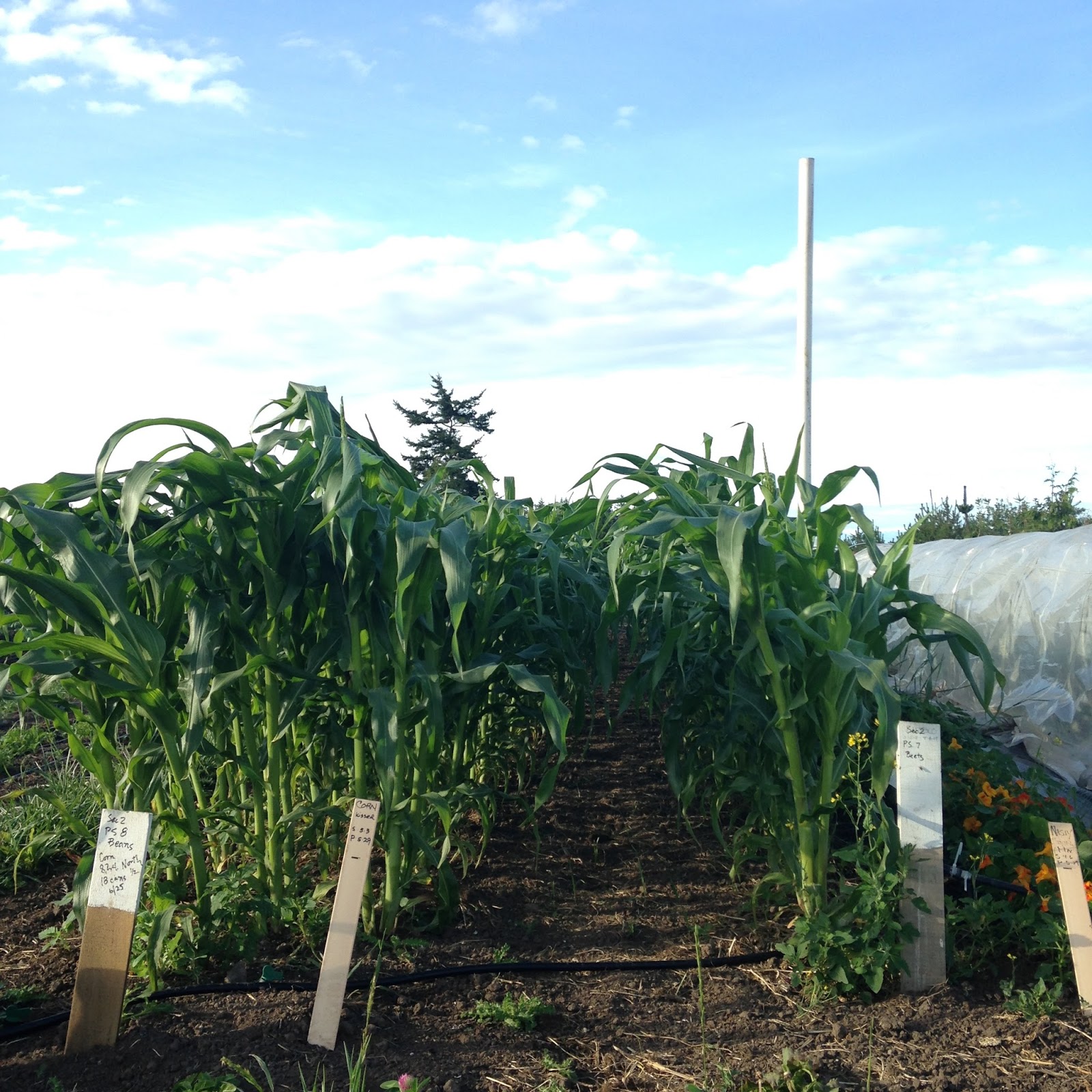
The corn grows (Siegner)


Note: The views expressed here belong solely to the author of each entry and are not representative of the position of the Energy and Resources Group, UC Berkeley.

6.19.2015


[Kripa Jagannathan, ERG graduate student] 

The drought has been a talking point for many Californians, but I have often wondered how farmers — whose livelihoods are affected by the drought and who are at the center of the water-use debate —view the drought.

I got an opportunity to hear from a farmer during my visit to the Masumoto Family Farm near Fresno in late April this year. The visit was organized by the University of California - Office of the President (UCOP) for the 2015 Global Food Initiative (GFI) student fellows. The Masumoto family of David “Mas” Masumoto, his wife Marcy, and children, Nikiko and Korio, spent time with the GFI fellows talking about the students’ interests in food and agriculture related issues. They invited us into their home for a day to experience life on a farm. In their 80 acre farm, the Masumotos grow organic peaches, nectarines, and grapes for raisins.

David “Mas” Masumoto giving the GFI fellows a tour of his peach orchards.
[Photo: Kripa Jagannathan]

As Mas walked with the GFI fellows, giving us a tour of his heirloom peach trees, we asked about his thoughts on the drought. Mas’s reply to the question was completely unexpected and pleasantly surprised us all.

Mas said that people tend to be extremely scared of the drought, and, while it is definitely frightening, he has now started to view the drought as “a mystery waiting to be uncovered, and as an opportunity for public service.” He went on to explain that the drought gives us all an opportunity to research and innovate on new methods for conservation and sustainable use of water – which would eventually lead to a “public service.”

He was quick to point out that the biggest challenge is that farmers get only “one shot a year” to experiment with a different water strategy or management practice. This year, the Masumotos have experimented with using about half of the normal water-use for a small sample of their peach trees. Mas says that a lot of times more water is used just for maintaining the cosmetic nature of the fruits i.e. to make the peaches bigger than they would usually grow.

Some of the GFI fellows and I with Mas Masumoto.
[Photo: Deanna Geddie]

A recent LA Times article reports that these experimental peaches turned out to be small, but packed with an intense flavorful punch. These seem to fit perfectly with the farm’s line of organic, ugly, and fabulous or “O, U Fab!” peaches.

Another fellow asked Mas how students can support farmers and connect with them for collaborative solutions to the water issue in California. To this Mas replied that farmers are usually very independent and hence are used to “self-learning.” Therefore, scaling down research to farm-level and re-framing issues and solutions as personal stories could help with connecting better to individual farmers.

I returned from the trip optimistic and thoroughly inspired to carry on working towards uncovering the mystery of how to deal with the current drought!

Masumoto farm’s “O, U Fab!” cartoon, where the peaches talk back!
[Photo: Masumoto Family Farm website]

Top image: Sun crest peaches from Mas Masumoto's farm [Source: Trevor H]


Note: The views expressed here belong solely to the author of each entry and are not representative of the position of the Energy and Resources Group, UC Berkeley.


© ERG. Design adapted from Main-Blogger Blogger Template.