Showing posts with label Development. Show all posts

8.27.2019

[Isa Ferrall, ERG Graduate Student; Jonathan Lee, ERG Graduate Student; and Jordan Freitas, Assistant Professor at Loyola Marymount University]

Every day, 300,000 people are being connected to electricity through efforts to achieve Sustainable Development Goal (SDG 7): “Ensure access to affordable, reliable, sustainable and modern energy for all.” For them, new access to electricity comes with a host of new data harvesting by electricity meters, appliances, and payment tracking. Unfortunately, this data is typically collected ad hoc and shared in a bespoke manner or not at all, with concerns about privacy and provenance taking a back seat to increasing electricity service. However, lack of attention to data management practices around SDG 7 is slowing progress and creating potential problems down the line.
Source:    Alex Radelich via Unsplash
Connection to electricity often also means new connections to sensors, data collection, and privacy concerns.
Source: Alex Radelich via Unsplash

Effective practices aren’t only about protecting the privacy of individual end users of electricity. There is potential to create real value through systematic data collection and expanding access to more stakeholders, and improvements require considering the position of each. We recently coauthored a freely available review article in a special issue of the Proceedings of the IEEE on energy access, describing 1) the stakeholders involved in the data ecosystem of SDG 7, 2) the types of data at play and how they are being used (or not used), 3) potential value and risks of sharing these to each stakeholder group, and 4) data management principles to incorporate moving forward. We lay out a framework that we hope can be a foundation for initiatives to engage stakeholders in responsible and effective data sharing.

The key stakeholders we identify are electricity users, micro-utilities (mini-grids and solar-home-system providers), macro-utilities (national or regional), governments, development institutions (e.g. the World Bank, United Nations Development Program, Sustainable Energy for All, or national aid agencies), and researchers. We group the types of data as technical (electricity usage, system and product performance), financial (transaction records and costs of service), or demographic (income, cultural affiliation, etc.).

The risks and values to sharing depend not only on the type of data, but who it is about, who is gaining access to it, and privacy mechanisms that are put in place. In the full paper, we explore these combinations and provide detail about the different possibilities and current practices. Through that exercise, we identified areas for mutually beneficial data sharing, others that require careful navigation of tensions, and those where risks outweigh potential values. We found that a common and open platform for sharing technical data can enable efficiency in a number of areas, such as utilities providing better data access to end users to promote energy literacy and efficient use, and aggregating larger consumption data sets for better demand prediction. We surveyed a group of different stakeholders at a 2018 workshop in Nairobi on Decentralized Energy Solutions for East Africa and the Role of Research, and some of the responses illustrated areas with more tension:

  • Micro- and macro-utilities sharing performance and cost data can increase competition leading to better quality service with fair pricing for users, but current market leaders may lose their competitive advantage
  • Government and development institutions will have better reporting capabilities, but contradictions between promises and performance may be revealed
  • Researchers can discover key insights and contribute to public education, but may risk using data that was improperly collected or poorly-documented

Our analysis suggests that fewer benefits are likely to be realized from sharing detailed – even anonymous – financial data of users without increased legal protections. Codesign of data sharing practices and platforms among all stakeholders is crucial to expanding access, realizing benefits, and mitigating risks. These discussions also need to be held in the context of changing regulatory landscapes and utility business models, so that data sharing practices can enable forward-looking goals and are not overly restricted by the needs of today.

We are actively continuing this work with a series of in-depth stakeholder interviews to contribute more primary data about perceptions. Please email Isa Ferrall, Jonathan Lee, and/or Jordan Freitas for more information on how to get involved or to participate in interviews.


This article was originally posted on the blog of the Thematic Research Network on Data and Statistics (TReNDS) - an initiative of the Sustainable Development Solutions Network (SDSN) that leverages the data revolution to support the implementation of the Sustainable Development Goals.

10.22.2018

[Esther Shears, ERG graduate student]


Three weeks into my trip to Rwanda this summer, I checked in to my last Airbnb. It was a lovely home in Kimihurura, a popular neighborhood for expats in the capital city, Kigali. My host greeted me and invited me to sit out on the back porch of the home as the late afternoon sun streamed through the trees surrounding us. He was a middle-aged French Canadian who worked in security. Once he learned that I was graduate student, here on a scoping trip to study land use and climate finance, he didn’t waste any time in sharing his opinions about the country with me.


“There’s no point to development work; they just won’t ever change.” He shared anecdote after anecdote with me, admitting that he was just glad to have someone to speak to (and swear in) English with.

“I see a guy pushing his old bike up the main road, it’s piled high with bunches of plaintains, and then he pulls a new iPhone out of his back pocket…” 

“[NGOs] want to provide water filters or offer clean water to homes, but families still prefer to collect their water from a common well because that’s where social life happens.”

“I’ve heard street fights break out with tribal slurs being used… you know it’s illegal to use the words Hutu and Tutsi but I still hear it in these cases.”

This went on for a while. I was a guest in his home. I just nodded along, exhausted from the four-hour long, hot and cramped bus ride I’d taken from Gisenyi that morning. If I had met him within my first few days in Rwanda, I might have been a little more surprised by his brazenness. But in just three weeks, I had seen and learned enough to know that my host wasn’t the only one that saw the tensions apparent in a modernizing, post-conflict society.


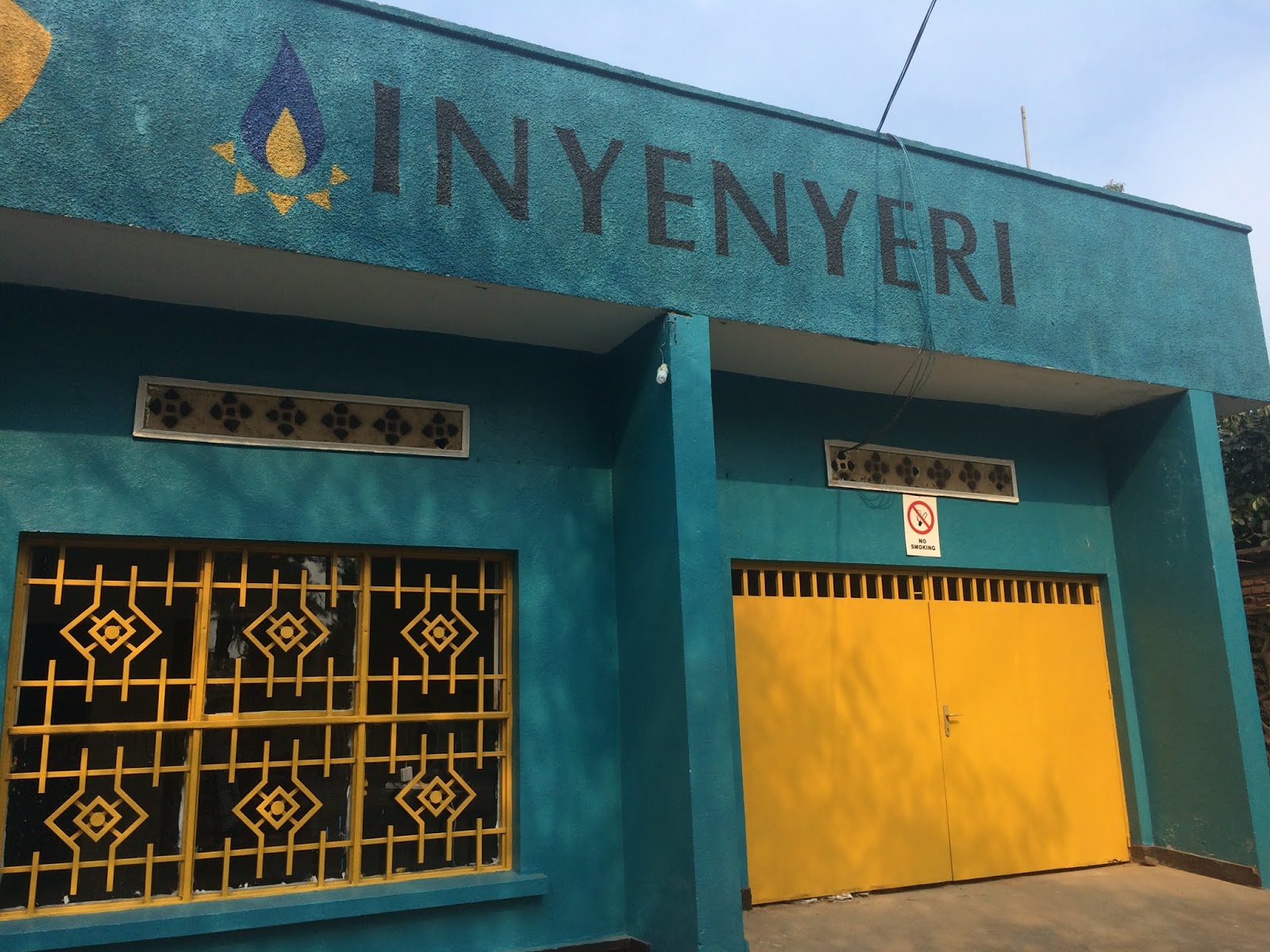
For a portion of my trip, I stayed in Gisenyi, a city on the north shore of Lake Kivu that sat directly on the border with the Democratic Republic of Congo. I spent most of my time there learning about the work of Inyenyeri, a Rwandan social enterprise seeking to bring clean cooking to both urban and rural communities with efficient fuel-pellet stoves.


The day that we took a field visit to interview rural customers also was the one day of the month that the villages in that region hold community meetings in the afternoon. As we turned off the perfectly paved and well-maintained main road connecting Gisenyi to Kigali onto one of the bumpiest roads I have ever encountered, the Inyenyeri staff jokingly introduced to me to the “African massage”: a ride in the back seat of a tightly-packed truck. On our way up the hillside, passing through several small villages, I could see groups of people congregated for these community meetings. When we finally reached our destination, it seemed to be the highest point around the region. The particular village we visited was selected by the company to start rural sales specifically because of how difficult it is to reach: “If we can make our business model work here, it can work in any rural village.”


I was interested in learning how the land was allocated throughout the community. The decisions were made long ago by the local village council – the best soil went to farming, and then the other areas were split between timber plots and housing. In recent years, more intense rainy seasons have raised concerns about flooding and erosion, and inspired nation-wide efforts to reinforce the terraces. As one of the most population-dense countries in the world, Rwanda has very little land left untouched.

Our interviews extended into dusk, and we had to hurry back to the truck to begin our long journey back to Gisenyi. Sandrine, Inyenyeri’s Communications and Marketing Manager, who served as our translator for the field visit, couldn’t stop gushing about how good the grilled corn was in these hillside villages. The community meetings had ended, and all the villages we passed on our way up had come alive as the sun set (which occurs promptly around 6pm that close to the Equator). Everyone was out and about, congregating around the open fires of crackling corn. I munched delightedly on a cob as Sandrine exclaimed over and over again, “I LOVE maize!


I was back in Kigali for the last few weeks of my stay. I spent the bulk of my time working in coffee shops, along with every other expat and white person, each undoubtedly working for one of the many NGOs sprinkled throughout the capital. You could bet without hesitation that any building in Kigali that stood more than three stories high was housing an NGO office. One of my goals for this trip was to meet with employees of these various development-oriented organizations. Through my conversations, I gleaned a few trends of how this industry operates in Rwanda.

Despite working towards a common mission of social good, a for-profit company isn’t necessarily afforded the same privileges in the development space as a non-profit: “If you were an NGO we would have two cars and staff dedicated to you,” a UNHCR worker reportedly told Inyenyeri while setting up their partnership at the Kigeme Refugee Camp.

Conversely, a One Acre Fund employee talked about how there were long-term opportunities for organizations functioning as social enterprises, but less so for non-profits: “As an NGO, you are aiming to make yourself irrelevant.” Social enterprises also tended to have higher proportions of non-international staff members involved in leadership positions within the organizations, perhaps reflecting an intention to remain integrated with the community.

It is important to build close relationships with local authorities. One employee from the social enterprise Jibu commented, “Since our water filters use WASAC water, we work directly with the water resource management… I would consider them as ‘partners’ – it’s important to have a good relationship with the government.”

Over 85% of the country works in agriculture, and climate change is already increasing instances of drought and flooding. At FONERWA (Rwanda’s climate fund), I spoke with Bright Ntare about the realities to come: “It’s not just energy and land-use work [we do], we’ll need to move people out of high-risk areas, so affordable housing is important to include… we need to consider employment opportunities in the long-term, because agriculture will decline with climate change. It just will. So, we are working on ideas for job trainings in other employment sectors. Finally, we are well aware that outside funds will not always be there.” People within the Rwandan government are already considering long-term strategies for funding climate-resilience.


My last fact-finding mission in Kigali took me out to Question Coffee, a project of the Relationship Coffee Institute. I’d flown past the Sustainable Harvest Rwanda sign while sitting on the back of a motorcycle (“moto”) on my way home one day, and suddenly made the connection between Sustainable Harvest Coffee Importers and the Question Coffee I had been drinking all summer from cafes around the city. The main café and educational center were not far from me, so I hopped on a moto on one of my last days and set out to experience the “best pour-over coffee in Rwanda” for myself. The Relationship Coffee Institute provides training for women-centric coffee cooperatives that promote transparent trading practices, practices for higher-quality coffee production, and higher prices (and therefore higher worker wages).

Just like many of the organizations I encountered during my time in Rwanda, Question Coffee presents a classic development success-story. I know that for every success-story there are many not-so-successful stories of similar projects. The uncertainties and complexities of development efforts are not new to me, having studied this work since my undergraduate years.

What struck me was the presence of a clear ambition for growth amidst a cloud of development fatigue. The positive energy and hope for the future were easy to see: in the recently-opened Kigali Convention Center, in the eagerness of anyone to talk with me about their work, and in the stated objectives of Vision 2020. But my awareness of the fatigue grew slowly, and finally came together during my visit to the Rwandan Genocide Memorial on one of the last days of my stay.

After the Rwandan Genocide, there was a huge influx of foreign aid and direct investment, not just for post-conflict reconstruction, but for broad development efforts in every sector of the country. Now, more than 20 years later, the aid is still coming, growth is still occurring, but for how much longer? In 2011, twenty percent of the country’s gross annual came from foreign aid. Since 2012, foreign direct investment has consistently surpassed 200 million USD annually. Yet, the country also appears to be reconciling with the reality that despite significant amounts of foreign investment, it won’t meet all of its Vision 2020 development goals. An excerpt from a 2018 IMF report on Rwanda’s progress summaries this tension between high growth goals and likely waning foreign development efforts:
“Building on its notable progress toward development objectives, the authorities are crafting a revised medium-term development strategy with the goal of achieving middle income status by 2035. To help achieve this objective, it will be important to regain momentum in mobilizing domestic revenue as a reliable source of financing for development.”
My conversation with Bright Ntare of FONERWA echoed this sentiment. He expressed excitement for all the work the climate fund hopes to achieve, while also acknowledging the significant challenge the country faces: how do we finance green growth when international flows run dry?

8.29.2018

[Samira Siddique, ERG graduate student]


Rohingya Camp
New paradigms

Currently, there are upwards of one million Rohingya refugees living in Cox’s Bazar, Bangladesh. For all the talk of moving the Rohingya elsewhere, such as Bashan Char Island, or repatriating them to Myanmar, it is almost certain that they will remain where they are for an indefinite period of time.

History has shown that the average age of a refugee camp is 12 years. Like most other refugee camp situations, this one will likely last for at least another decade.

Many NGOs and aid agencies that are working on Rohingya issues realize that this is not temporary, and are starting to take a longer-term view of the camps. The shift from emergency relief to development has begun, underscoring the fact that the refugee crisis has huge long-term implications for how development operates beyond state citizenship.

The Rohingya crisis is a useful case study to understand how refugees are slowly being brought into the traditional development framework. The scope of facilities and programs set up by the International Organization for Migration (IOM), UN Refugee Agency (UNHCR), and the hundreds of NGOs working in the camps over the past year is remarkable.

They have built camps from the ground up and organized them into zones with basic roads and latrines, tubewells, health facilities, and community centers. However, the separate institutions that are in place to deal with longer-term development and emergency relief are not aligned in their goals. This affects the extent of aid given, the type of facilities that are built, and of course the economic and political rights and social support that the Rohingya have.

A strong indication of the shift toward development in the Rohingya camps is the recent investment from the World Bank and Asian Development Bank (ADB), of $480 million and $100 million respectively. Traditionally, these two institutions have invested in long-term development projects and supported governments in capacity building. In the past few years, they have created a relief fund for emergency situations exactly like the Rohingya crisis.

One of the investments from the World Bank and ADB is in renewable energy in the Rohingya camps. The investment in energy access shows a gradual shift toward longer-term, or at least medium-term, planning in the camps. Compared to international aid funding in every other sector—water and sanitation, health, shelters, etc.—energy had no allocated funding at the beginning of the Rohingya influx.

This is largely because energy is not seen as essential to emergency relief, which is arguably an outdated view from the aid industry, as energy access is linked to more positive health effects and gender safety and equality. Now with the World Bank and ADB’s investment plan, there is a portion allocated to set up some solar mini-grids in 2019, as well as constructing more solar lamps and distributing solar lanterns.

Historically, there has not been a systematic approach to energy supply in conflict settings because they are thought to be shorter term. Most of the energy is supplied ad hoc by individual NGOs or international aid agencies, usually through diesel generators. The move toward renewable energy shows increasing interest in long-term development because it is inherently sustainable and simple to use. A solar mini-grid offers a cleaner and more consistent alternative to diesel generators, and can potentially be used to anchor local mini-grids if the refugee camps are present in the longer term.

Out of all the Rohingya camps, it is striking that the only one that is connected to the national electricity grid, and thus situated for longer term, is a camp in Teknaf, where some Rohingya have been around for many years and have essentially assimilated into the surrounding community. Perhaps the thought here is that there is “value added” if the Rohingya contribute economically, so it makes sense to invest in electricity lines. However, this situation is exceedingly rare, as the vast majority of Rohingya cannot move freely outside the camps and thus are unable to be economically independent

While the notion of development is important for improving livelihoods, the development itself must be done differently for the stateless. Traditional forms of economic development do not work for stateless people who have no means to gain employment. Though there are some cash-for-work programs and recreation facilities set up by aid agencies, the vast majority of Rohingya have nothing to do during the day; their routines are often set around food and aid distribution schedules. They are recovering from unimaginable trauma. The camps will only continue to grow: Rohingya are still crossing the border, though at much lower rates, and there are projected to be 50,000 babies born this year. No amount of aid distribution or traditional notions of development will fix these facts of life for the Rohingya.

Part of the difficulty in streamlining development efforts is the institutional power structure of the camps. Since the exodus began in August 2017, the Bangladesh government has not officially labeled the Rohingya as “refugees.” Without this label, UNHCR could not head the emergency relief operations in the camps, as they normally would when refugees are involved. Thus, IOM took over camp operations. Within a few months, UNHCR was allowed to work in the camps and it started co-leading operations with IOM. The two humanitarian stakeholders now oversee relief operations in about 10 sectors and work alongside the government’s response to the crisis, which includes different government agencies and the Bangladesh army. This web of agencies does not have mutually exclusive goals, but since they do not normally collaborate in this way it has been challenging to settle on long-term goals.

Another challenge is that there is no direct guiding principle globally for how to integrate stateless people, let alone how to develop communities with them in mind. One of the main guiding principles for long-term sustainability planning is the UN Sustainable Development Goals, a set of 17 goals that aim to end poverty with strategies that build economic growth and address a range of social needs including education, health, and environmental protection. None of the goals explicitly address development for stateless persons.

International NGOs and the UN could adopt a more explicitly rights-based approach to development, especially as more refugee crises and mass migrations are projected to occur in the future. This approach would combine different existing concepts of international development, such as capacity building, human rights, participation, and sustainability. The goal would be to empower the group that cannot exercise full rights and to strengthen the capacity of institutions and governments obligated to fill these rights. However, the main criticism against the rights-based approach is that it merely incorporates the language of human rights with development, but does not change the programs being implemented. In order for change to take place, governments must be willing to accept refugees and migrants, and hold other countries accountable for the processes that lead to refugees in the first place. Many governments that receive refugees, whether willingly or not, are not capable of developing long-term communities for the refugees in their own country.

There are currently about six million people in protracted displacement situations globally, and even more migrants, who are not officially given economic and political rights by the state. Crises like this will only continue to happen at varying scales, whether through ethnic cleansing, environmental disaster, economic crisis, or something else. The UN, development agencies, NGOs, and some governments are only just beginning to rethink how we prioritize refugees and migrants and integrate them into existing development frameworks. There will be many lessons to learn from the Rohingya crisis for years to come. A likely one will be how to conceptualize development for those that have been systematically “othered” and persecuted.

This article was originally posted on Dhaka Tribune.

7.12.2018

[Kelly Jiang, undergraduate researcher at the Renewable and Appropriate Energy Lab]

金盆村 (Jinpen village) is a spectacularly beautiful place in the lush forested hills of Western China, with freshly paved mountain roads winding through steep terraced fields. The fields are filled with all types of crops – ranging from rice and corn, to radishes, greens, cucumbers, tomatoes, sunflowers, lotus, and even crayfish.

Golden hour from a random spot on the road. The single lane concrete road pictured here goes into the fields and was probably paved very recently (in the last 1-2 years) as the Chinese government is working very hard and putting a lot of money into trying to eliminate absolute poverty by 2020.

Jinpen village is partway up the mountain, and provides spectacular views into the valley several hundred meters below. It’s incredibly remote – the drive to the nearest county seat, Nanjiang, takes about two hours on winding mountain roads – and Nanjiang itself is a four-and-a-half hour drive from Chengdu, the capital of Sichuan province. Despite its remoteness, the Chinese government has spent a pretty significant amount of money on building up the village. Twenty or so new houses were constructed a couple years ago in an effort to encourage people to move from the fields into the village center. The houses are extremely large: the one we lived in during our stay had four bedrooms and two full bathrooms, and some houses are even bigger.

However, many of the houses are uninhabited – most people prefer to live in their ancestral homes in their fields, since there’s not much for them to do in the village center anyway. There’s one road that goes through the town, an elementary school, a carpentry shop, a police station, two convenience stores, and… that’s about it. So, although it may appear that the area became more “developed” as the town doubled in size with the construction of these new houses, that appearance of development means nothing if there are no economic activities to partake in.

The owners of the house we stayed in don’t actually live in the house, which is why we were able to live there – like many others, they prefer to be close to their fields where they’ve grown up and subsisted off the fruits of their own labor for decades.


The Project

I was in Jinpen as part of the IEEE Smart Village project, which “integrates sustainable electricity, education, and entrepreneurial solutions to empower off-grid communities.” In places where many communities are incredibly poor and lack even basic electricity, installing renewable energy systems in off-grid areas can have a huge impact on those communities’ quality of life. However, merely providing electricity is not necessarily sufficient to achieve economic development benefits – electricity must be but one part of a holistic sustainable development program. Power for All finds that “[m]any factors are critical to establishing PUE [productive uses of electricity] beyond just energy access itself, including capacity development, business permitting processes, access to finance and transportation infrastructure.” [Source] That’s why the smart village project aims to combine energy access with education and entrepreneurship, so that electricity can be an enabler of different types of economic activities such as internet cafes, barber shops, food processing, and much more that would not have been possible without electricity.

For the IEEE smart village project in Jinpen, a 16.2 kW grid-connected solar system was installed on the rooftop of the school. The solar system sells the power it generates to the power grid, allowing the school to save money on electricity and possibly even use the solar energy as an extra source of income. Any extra money is valuable to the school, which is quite cash strapped and has difficulty retaining its teachers due to its remote location.

The population of Jinpen elementary school keeps shrinking as more and more people move from rural areas to urban areas. The graduating 6th grade class this year had 14 students, down from 20 a few years earlier. There are 7 students in 5th grade, and 5 students in 4th grade – 4 next year, after one of the students moves away. There are 84 total students in the school. And Jinpen elementary school is actually one of the larger elementary schools in the area – another elementary school a couple miles down the road has only 5 students. Yes, FIVE students. Across all grades.

The mass migration of people from rural areas to urban cities is happening all around the world, not just in China. It’s happening in the United States, where small towns have been shrinking for decades. Schools in rural America are shrinking and closing, too. So that begs the question: Is this urbanization trend irreversible and just something that we should accept? If so, does it even make sense to be investing so much money in rural areas’ development if people are all leaving? If not, then what kind of economic activities can be developed in these rural areas? These are difficult questions, and we need to be thinking about them a lot more than we are.
~~~

Anyway, back to the project that we were working on – the 16.2 kW solar system installed on top of the school. Funding to build the system was donated by a variety of individuals and organizations, including Sichuan University, various renewable energy companies, etc. The total cost of the system was about US$25,000, or ¥150,000. It was wonderful to see so many people from the public, private, and nonprofit sectors all come together to support the project – it’s been a really long process to raise all the funds and coordinate all the parties who contributed to the construction of the system, and it’s a testament to the generosity and capabilities of the project organizers, especially Xiaofeng Zhang, that this project was able to become a reality.

Since the system is grid-connected, it’s essentially just selling the solar energy it generates to the grid – at a higher price than it costs to buy energy from the grid. Thus, the school is selling (expensive) solar energy to the grid, while buying (cheap) electricity from the grid, resulting in savings.

One of the paths to a family’s home. Yes, this is actually the trail. If you look closely you can kind of see it. That family had electricity.

Since the school is already connected to the electricity grid, as are all of the homes in the area (even the ones that are only accessible by hiking for 1km or more on dirt paths that can be incredibly steep and get super muddy in the rain), putting solar on the school doesn’t really provide a meaningful benefit when it comes to electricity access. It’s worth emphasizing what an incredible accomplishment it is that China has been able to provide electricity access to every household in the country – that’s a huge infrastructure project, and China is probably the only country at this point that could do something on that scale.

(Aside: grid extension is probably not the most cost-effective way of electrifying rural areas, as building out transmission and distribution lines for so many hundreds of miles to carry relatively small amounts of electricity is really, really expensive. A single rural grid connection in Tanzania can cost US$2,300, compared to an off-grid solar system that costs US$240. [Source: Power for All] Thus, in many unelectrified villages, it is far more cost-effective to install solar home systems or microgrids, rather than extend the central grid. Hence, the IEEE smart village project aims to bring solar home systems, irrigation pumps, and microgrids to unelectrified villages, rather than using grid connection.)

Anyway, since the benefit of this system doesn’t come primarily from the fact that it’s providing energy access, it’s all the more important to ensure that the educational benefit to the students is maximized – that the students really understand how solar energy and other forms of renewable energy work, why renewable energy is important, etc. Ideally, the solar panels would also be integrated into the school curriculum on a regular basis.

As part of the focus on education in this program, the solar system was designed specifically to show students some of the different considerations when designing a solar energy system. There were three different kinds of trackers installed on different panels – some were connected to a flat single-axis tracker, others were connected to a tilted single-axis tracker, and others were connected to a tracker that students can adjust to tilt more or less towards the south as the seasons change. There were also, of course, fixed panels tilted towards the south that weren’t attached to trackers. The idea behind this is for students to see firsthand how solar energy is affected by the angle of solar panels throughout the year. Additionally, the students should have a sense of responsibility and ownership of the solar panels that they adjust every two weeks to keep up with the changing angle of the sun.

On the rooftop with the students and solar panels!

Another potential benefit of having solar installed on the school is that it could continue to provide power to the school during power outages. Most unfortunately, the solar system didn’t actually have islanding capability (i.e. the capability to separate itself from the grid during an outage), which pretty much negates the most obvious use case of the solar system for the school. However, if they get a bit more money in the next few years, they can implement the hardware needed for the school to island itself from the grid. That said though, it would have been ideal for the system to be completely designed and built upfront so that the school could have access to all the benefits of the solar system from day one.

But that’s a lesson learned that can be applied to the next smart village project! They’re actually planning to expand the smart village program to 200 schools within the next five years (a “Five Year Plan”), so there are lots of opportunities to improve on the system design for future projects.

It’s also important to keep in mind that sustainable development projects must be maintained over the long term. It’s all too common to do projects like this, put on a show to announce that the project has completed, then walk away without thinking about the long-term impact. Especially as the IEEE smart village program aims to expand to 200 schools in the next five years, I really hope that there’s an emphasis on ensuring that these projects are focused on making the greatest impact in the villages where they are installed. Quality over quantity.

In my discussions about rural development with my advisor at Chongqing University, he commented that many development projects in China are completed to the extent that officials will be able to point to their work and say that they hit whatever target the Five Year Plan had set in place. For instance, China has a target of eliminating absolute poverty by 2020, and the Chinese government is throwing huge amounts of money at this target so that they can say, when 2020 rolls around, that this target has been met. However, the real key, my advisor said, is to see the status of rural development in 2025, in 2030, in 2050. After the attention fades away, have the local communities developed new types of economic activities that can be sustained? Or does the government need to keep spending billions on these communities to keep them afloat while the rest of the world moves on?

Read the rest of this post on Kelly's personal blog, The Procraftination.

9.06.2015

by Diego Ponce de Leon Barido, ERG PhD Candidate
with team members Javier Rosa (TIER, UC Berkeley), Stephen Suffian (Villanova University), and Odaly (Nicaragua local team)

I feared the worst: The bags had been thrown around at customs damaging our gadgets, the humidity and heat had fried our circuits, mice had eaten away at the cables, and our equipment was now being sold in Managua’s electronics black market.

Our ultimate objective for the trip in Nicaragua was to deploy a wireless sensor network in thirty micro-enterprises and households to monitor and inform the design of a micro-level demand response implementation for renewable energy integration.

One of the most stressful moments of our two and a half-month implementation was the ride back from customs to our home-stay, after recovering all our equipment. On my ride back, I shared a tiny Nissan car with two strangers with some of our equipment being tied to the car’s roof with the rest of the equipment overflowing the Nissan’s tiny trunk. The bags also weighed much less than when we initially handed them off at customs, but stopping to check the bags’ contents in the street could have meant losing even more equipment to petty theft.


We planned to be in Nicaragua for two and a half months. We allowed for failure in our mind, knowing well that we could only plan for the few things that we could control, and left extra mental space and time for the natural uncertainty of bureaucratic processes, as well as all the unforeseen mistakes that our team would surely make along the way.

Basically, we planned for what we could control, and assumed that good luck and hard work would take care of randomness. First, we would forget nothing back in Berkeley. Then, our technology would spend exactly two weeks at customs, and Nicaragua’s National Engineering University (UNI) would help us release it without paying taxes. Because we had tested our hardware and software ad nauseam in Berkeley, our deployment would be a simple "plug and play," and we would "figure out" communications for a demand response implementation "in country."

Customs was a nightmare that required 15 full days of absolute patience, cultural navigation, and polite pestering
Again, our objective was to deploy a wireless sensor network in thirty micro-enterprises and households. We call these "sensors nodes" a FlexBox. In the end, we implemented 29 (out of 30) partially working FlexBoxes in Managua, and kept one for future testing in Berkeley.

Customs was a nightmare that required 15 full days of absolute patience, cultural navigation, and polite pestering (and thousands of dollars paid in taxes). Our hardware passed most tests, but some sensors failed in the field after being exposed to being thrown around, drowning in freezing water, and sharp metal doors searing connections away. We got carried away in what we thought would be useful (but not necessary) software developments instead of focusing on a bulletproof version of our minimum viable product (MVP), and were not even close to "figuring out" a cost-effective communications protocol in Managua.

However, despite our "natural" missteps (things that can go wrong, will go wrong), we have begun developing a unique regional dataset which will allow us to correlate micro-level demand and behavior, to grid level measurements such as system frequency, generation from fossil and renewable resources, and weather data.

Our project also considers increasingly important equity implications of smart grid deployments: How are data exchanges mutually beneficial? How can urbanites be more engaged in a low carbon transitions? How can renewable energy based grids provide higher quality service and useful information to their clients?

To our knowledge, our project is the first of its kind in the region and will greatly contribute to shedding light on how existing grid infrastructure can be used to further increase the equitable penetration of uncertain and variable renewable energy.


SURVIVING IMPLEMENTATION
Throughout this process, our team learned a lot about what it takes to go from plans to implementation. Below are ten takeaways for future implementation that other researchers introducing new technology into foreign countries may find useful as well.

1. Customs
Depending on where you are traveling and what technology you’re deploying, your experience will vary drastically. If you are in a country where rules, guidelines and regulations are carefully detailed and followed your job is easy – read the rules and play by the book and most likely you won’t have a problem. However, if you are in country where everything is routinely improvised, you’ll most likely be at the mercy of a local customs agent at the beginning of your first "in country" adventure.

Make sure a handy person in your team is fluent in the local language and culture, you have "extra" money in case you need to hire a customs agency, and that your patience "hat" and best manners are at their best all the time. Two to three weeks is normal operating procedure, if you do everything right. If you make mistakes, don’t have the right permits or forms, or are being regularly scammed because you don’t understand the language well enough, this process could take months.

Our technology traveled from San Francisco...

... to El Salvador...

... to the customs of Manauga...

... and finally to 29 homes


2. Parts
Bring an extra set of cheap "parts" that you may not be able to find in country. Doing your due diligence is very important. Make a list of the things you can find in country and a list of things you can’t find in country. Bringing extra things that you can’t find in country will cause problems at customs, so make sure you have lists of parts. Bring an extra two or three "final products" (whatever those may be). Regardless of how good you think your product is, you’ll have to keep iterating in the field – having a working final product as a test bed while you deploy is very important.

3. Money
If you are working on a tight budget, you’ll have to be very creative about how you spend your money. Besides your technology, and if you have a team, you will all have to stay in the same place (and that place must have a good working space). You’ll also need a car, money for food, extra parts, and many other things that will show up as you begin your project. You’ll also need to hire a local team, both for the deployment as well as for your project’s follow up.

Although "strong collaboration" with institutions is important, and "community ownership" and "partnerships" are essential (these buzzwords are all the rage in development circles), nothing gets people working – at the pace that you want them to work like money. Be wise in how you spend your money, and prepare a detailed budget months ahead of time.

4. Contacts
You’ll soon find out that your Berkeley education and prior experiences mean very little once your project "breaks ground"
Things will inevitably go wrong. Make sure that you have friends and connections in the right places. Our team had signed collaboration agreements with the National Engineering University, the Ministry of Energy and Mines, and a local renewable energy startup. None of these signed agreements meant much until we needed to show that we knew people in high places, and that they were keeping a close eye on our project. Keep those signed agreements handy, you never know when you might need them.

5. Local Team
Nothing – NOTHING - happens without a local team. You might think your clever engineering skills have taken you far in life, or that your Peace Corps experience has turned you into a community relations expert, but you’ll soon find out that your Berkeley education and prior experiences mean very little once your project "breaks ground."

We hired a community liaison (Odaly), an electrician (Roberto), and an electronics engineer (Jorli) to work with us throughout the implementation and to stay with us through follow up. While we handled the implementation logistics and directed everything, they were heavily involved in troubleshooting, surveying, and follow up. They have all learned a wide variety of skills along the way, such as fixing broken sensors, accessing PostGRES databases, and setting up a local WiFi network.

Once you leave, you need to make sure that there is a team of people that will be able to solve problems as they arise. Without a good local team, your project will last only about two to three weeks post-implementation.

6. Build/Deploy Team
A small team needs to be composed of people with interchangeable skills that complement each other well. (Three people sounds about right). One person can be responsible for a lot but not for everything. If your project is technical, then everyone in your team must be able to help, or everyone must be willing to learn (fast). There will be plenty of times for PANIC to sneak in.

If you’re leading, you can never panic. If you’re someone who panics, control yourself. When things get hot, you’re stressed, or you’re panicking, control yourself. Drink water. Take a break. Be respectful. Try not to complain (too much). Nothing sucks more than having to deal with a difficult situation, and with someone who is complaining about it.


Javier and Stephen did A LOT of hacking to get an excellent MVP

7. Respect your MVP
You arrived to your site with a minimum viable product (MVP). You have something that works. Your goal should be to make that product work on site with as little change as possible. Don’t add components (hardware or software) to your MVP "in country." You need time to test new additions, and more time to make them work like you want them to. Additional things can be done once your MVP is fully functional on the field. Until that point, eschew any ideas to make the product better, faster, or easier to use. Any improvements should have happened during the testing phase and can happen when you’re done with your deployment. If you have a short deployment time, respect your MVP.

8. Time
You should leave, at minimum, three weeks of follow up after you have finished your deployment.  Things will fail and break, and you need time to fix them. You also need time to train your local team on troubleshooting. Leaving a country right after deployment is symptomatic of the "parachute" approach that most "development engineers" work with (drop in, have your adventure, drop some technology, fly off to another adventure). After your deployment, do your due diligence and stay in country to finish the training with your local team, make and solve problems, troubleshoot, and prepare your project for the next few months before the next iteration.

9. Release
Deployments are high-stress situations. Make sure that you’re doing something fun the entire time. Bond. Keep things fun. Remember that no one is forcing you to do this, so make sure that you’re enjoying life while doing it. If not, what’s the point?

10. Humility, Respect
Respect the people you’re working with. Respect your local team. Respect each other. Be humble about what you can accomplish. Accept and apologize when you make mistakes. Accept others' apologies. Don’t dwell. Ignore the little things that don’t matter, but REALLY pay attention to detail. Appreciate your team, you’re part of it. You are all learning from each other.


Our project looks to use thermostatically controlled loads at the micro-level to develop cost-effective strategies for renewable energy integration.


Note: The views expressed here belong solely to the author of each entry and are not representative of the position of the Energy and Resources Group, UC Berkeley.

5.21.2015

[Pierce Gordon, ERG PhD candidate]

“Berkeley is less than the sum of its parts.”

This quote, from the esteemed professor Richard Norgaard, is what I remember most from my first day at the Energy and Resources Group. He dropped this intellectual bombshell, and kept speaking as if the statement was trivial. However, I couldn’t shake its weight, and I knew how truthful it was while I progressed through graduate study.

Pierce and the Idea Team chart Berkeley's "stars" (Image: Jessica Sarrazin)

As a scholar changing disciplines from aerospace engineering to international development, I realized the only way to gain experience was to get involved in the community on campus. I became acquainted as quickly as possible with researchers, coursework, and colleagues that showed me the professional opportunities. But, it still wasn’t enough. Where could I find my own personal niche in international development on this campus?

We realized our beloved campus is filled with star researchers and practitioners; we then realized a worthy cause for the Idea Team was, in a sense, to chart the constellations.
Serendipitously, an email from the Development Impact Lab (DIL), asked for passionate graduate students charged with “helping to shape both DIL’s student engagement work and the larger campus dialogue on science and technology for global good.” For one who needed exposure and experience, this was the perfect opportunity.

As the inaugural class of ‘Idea Team’sters, we basically had free reign to develop any ideas to help the DIL community we desired. With power, however, comes paralysis; if we could chart any path, where should we head? What are the biggest issues the extremely diverse international development community has on our campus? And, what exactly can a group of interdisciplinary graduate students, with little time and intersecting interests, offer such a community?

In a way, this is where I channeled the sage wisdom of our precious Dick Norgaard. As I repeated his quote to my colleagues, I realized one interpretation; the disciplinary silos of the Berkeley community are exceptional, but the connections are ad-hoc and unsustainable. We realized our beloved campus is filled with star researchers and practitioners; we then realized a worthy cause for the Idea Team was, in a sense, to chart the constellations.

And, chart we have tried.

Pierce Gordon

The Idea Team has presented some novel events (at least, we think so) to intrigue the development community, including the first DIL Open House, the two DIL Innovation Crawls, and the recently completed Fail Faire at Berkeley. It’s been difficult to bring people together, however. Even with twelve graduate students at its peak, the development community has been difficult to incentivize. This is why for all projects, passion at the beginning and follow-through at the end, are critical skills for success.

The great thing about the Idea Team is the quick turnover; with new ‘Teamsters’ come new ideas. We always welcome new ideas, directions, or even Berkeley-centric problems. What do you think DIL should work on? Respond here!

Regardless of the direction of the future team, it’s been a pleasure helping to chart the path for two years. Hopefully, with time, the efforts of the Idea Team can bring us together – and maybe, direct us towards our collective goal, of positively impacting the global poor.

To learn more about DIL, watch the video below.


3.27.2014

[By Dimitry Gershenson (ERG Grad Student) and Brian Edlefsen Lasch (MicroEnergy International)]

Village Mini-Grid

Symposium: UC Berkeley, April 10 – 12, 2014
Innovating Energy Access for Remote Areas: Discovering untapped resources

Flying out to San Francisco, the hills look like waves of mountains, rolling toward inland California farms. Situated within this amazing landscape is one of the world’s most innovative communities working on inclusive and sustainable energy. Numerous universities, start- up entrepreneurs, financiers, technology companies and consultancies address distributed and affordable energy markets in myriad countries. In less than two weeks, prominent researchers and scholars in this field will arrive in the Bay Area, and spend two days discussing pressing issues in expanding energy access: policy, finance, implementation, technology innovation, and more.

On April 10th, MicroEnergy Systems (MES) and the Berkeley Rural Energy Group (BREG) will be holding the first joint MES/BREG symposium on Innovation in Energy Access for Remote Areas. Hosted by Prof. Dan Kammen (Renewable and Appropriate Energy Lab) and Prof. Martina Schäfer (Technische Universität Berlin), BREG and MES have invited over 50 Presenters, academics and practitioners, from around the globe to focus on the special theme of 'discovering untapped resources'. Select papers will be published in the journal Environmental Research Letters, and will also be considered by Springer Press for addition to a special edition book. The local Bay Area Energy Access community, notably through networking organizations such as Energy Access SF, are invited to register their attendance and represent their organizations. For Day 3 of the symposium, attendees are also encouraged to book their ticket for an optional day of exploration and networking. A driving tour will take you across three bridges of the San Fransisco Bay, including a guided visit to the California Academy of Sciences and an outdoor picnic in a Golden Gate Park museum courtyard. RSVP only (to Dimitry Gershenson (d.gersh@berkeley.edu), limited tickets available (cost: $60/person or less depending on demand.)

April 10th and 11th
2 days of presentation and discussion, including light workshop sessions.
30 new papers, presented in concurrent sessions and plenaries.
20+ poster topics, presented during an evening mixer at the Blum Center for Emerging Economies.
4 different venues, explored by participants across campus.

Support this good event by registering at:  http://www.microenergysystems.tu-berlin.de/conference/registration/  (Please Register by April 2nd)

See you soon,
with our best regards,

Sebastian Groh, MES, Dimitry Gershenson, BREG, Jonas van der Straeten, MES, Brian Edlefsen Lasch, MicroEnergy International (MEI), Liisa Andersson, MEI


© ERG. Design adapted from Main-Blogger Blogger Template.