 |
| Photo credit: Garima Srivastava |
This Life@ERG blog post is... uh, well overdue. I promised I would submit one a year ago. I think the hesitation to write came from the difficulty in deciding which facet of my life I should discuss. And in pure procrastination fashion, instead of facing my roadblocks, I about-faced and marched towards a myopic whirlwind of anime and kicking it with mis amigos.
Now after such and such, here we are. I’ve decided to write about a concept that has grabbed at my consciousness at a couple points of extrospection. One point comes from reflection at the punctuation of my academic career (I graduate this coming May), remembering the fact that I was often one of the few -- or even the only -- black person or person of color in the room. The second comes from observation of the current U.S. Congress and what these midterms election meant for the future of our democracy.
The idea picking at me, as you may have guessed, is that of underrepresentation, or its more underrated co-star, overrepresentation. These may seem like two sides of the same coin. But focusing on underrepresentation breeds tokenism, whereas focusing on overrepresentation highlights the structural, systematic unbalance in society. I'm also an energy nerd, so I can't help but draw an analogy between the two: Is there something we can learn about representation from our energy mix?
An Example
Two years ago, I worked as a summer fellow for a CPUC commissioner. I had tried again and again to get a position with a commissioner who was an ERG alum, and a black woman no less. But that card wasn't in the deck. And through the processes that be, I instead got an offer to work with a commissioner that happened to be a white man. I was no stranger to being a black face working for a white one (I completed high school and college in Iowa... and the US), and jumped at the opportunity. Maybe it seems like I was setting something up here with the introduction, but it was a great experience, and I now look to said commissioner as a mentor and role model.This experience, however, was something of a unicorn. I realized how rare a situation this was one day when I was sitting in a commissioner voting meeting. I looked up to the dais and saw a satisfying spectrum of diversity: two white men, a black woman, a Latina woman, and a brown woman. Ahh, perfecto (Well, kind of. The department staff was mostly white, and the "front desk and security" staff were mostly POC. But that's a different story, for a different day).
I couldn't help but think that I would have felt differently about my experience if I looked up that day and instead had seen a bench composed of five white men (or even a combination of white men and women, for that matter). But because there was clear and evident diversity, I actually enjoyed my experience working for this man. What a novel idea.
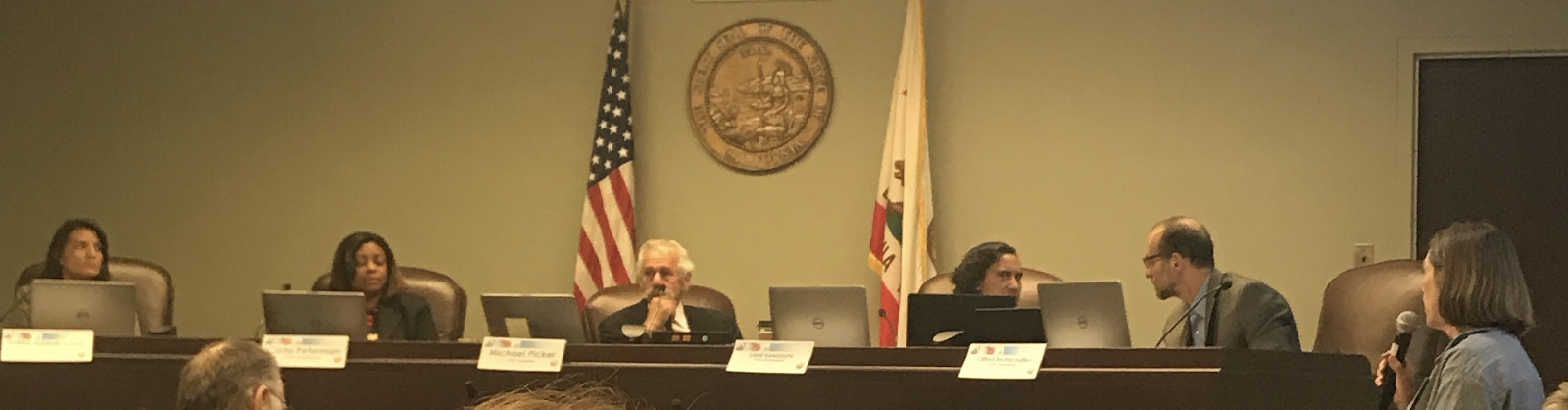 |
| California Public Utilities Commission (CPUC) voting meeting on June 15, 2017 |
The Analogy
Let's talk for a moment about the U.S. energy mix. For the longest time, coal and oil were cheap, and they were easy. But there was a dark secret hidden in the black plumes of exhaust. The black plumes of exhaust were killing the planet. The industry was resistant to change, but eventually, we began to take small steps to change the energy mix. Many want to establish a national carbon tax or California-like cap-and-trade system to account for their negative externalities. This way, we can make room for natural gas and renewables. The goal: a cleaner energy system and thus, less environmental pollution.One might say that we’ve become enlightened and see the overrepresentation of coal and oil in our energy mix as a negative. But still, progress is slow. We’re three-quarters century in, the planet continues to weep, and those who benefited least from the pollution look to be the ones who will bear the highest costs.
The Thesis
Hopefully, the analogy was apparent. Coal and oil represent our early approach to an energy portfolio, like how a mostly white (man) composition of powerful positions has been our approach to diversity (or lack thereof). The difference is, a lot of the world recognizes this overrepresentation of dirty energy as an issue and is working to correct for their negative externalities. While many of the elected offices, top universities, corporate leadership, etc., however, have not done the same for diversity.One explanation could be that when the earth weeps, it literally storms, and there's nothing anyone can do to stop it. Whereas it’s sadly much easier for the powers-that-be to disenfranchise people and squash race riots and self-separatist growth when they are weeping.
I believe a more likely explanation could be the persistent conflation of accessibility and efficacy. It's not enough to open doors to diversity and hope that institutions will become diverse. We must account for the negative externalities that got us here in the first place. Some may not remember, but solar panels used to cost a whole heck of a lot. But many government subsidies and cheap manufacturing deals later, we now have solar panel-borne energy out-competing coal. This was/is not a passive process, and neither should be diversity. If diversity is the goal, we must put our money and energy where our mouth is to actively overcome the structural inequalities that have gotten us here: ahistorical policies, disparities in intergenerational human capital and wealth accumulation, and "intrinsic" privilege.
With every iteration, we need to look at our diversity mix and appreciate the signals it sends us. An overrepresentation of coal and oil in our energy generation portfolio mix means we have an environmentally mediocre mix. Likewise, a mostly white (man) composition of our positions of power can be a mediocre one full of untapped potential. In the U.S. context, wherever we see too many white people in positions of power, our Scooby Doo jinkies meter should be at peak. With changing demographics and a growing pipeline of talent, the laws of probability suggest that we are seeing a failure in the market whenever we observe this phenomenon.
That black plume can become clear if we go fishing (read: perform outreach) instead of leave with whatever turns up in our nets, optimize on equity instead of efficiency, and implement a plan to normalize diversity rather than let "the market" figure it out. And over time, we won't even need to subsidize diversity because it will out-compete overrepresentation on its own.
Notes: (1) Positions of power include the rungs on the ladder of mobility to said positions, including higher education. (2) Not everyone agrees on human-caused and/or -accelerated climate change as evidenced by the US's withdrawal from the Paris Climate Agreement. Those people don't see a problem with our divers—I mean, energy mix.