Showing posts with label USA. Show all posts

5.14.2015

[Laney Siegner, ERG graduate student]

“Only in the past decade has farm to school emerged as a movement to change the way children understand food and to offer farmers new markets for what they produce.” (Beery & Joshi, 2012) 

Tasting reception at Monterrey High School featuring food produced by participating districts in the California Thursdays initiative.

At the Asilomar Conference Grounds, there was a palpable excitement for those present of being in rooms full of farm to school enthusiasts. Although hailing from a variety of backgrounds and job titles (teachers, farmers, school administrators, food service directors, school “chefs,” non-profit leaders, school board members, parent volunteers, and academic researchers), all were enthusiastic about the premise of providing real, healthy food to schools from local farms.

The Farm to School program in California currently involves over 85 school districts, of which Berkeley Unified School District was the first district in the country to pass a progressive food policy recognizing the connection between healthy eating and effective learning. On May 4-6, 2015, over 250 California “first responders” to the national health care crisis convened in Pacific Grove, CA for a state-level Farm to School conference.

Conference attendees were encouraged to take a "holistic view" of how fresh produce contributes to school curriculum and education. Laney is the corn with the tennis racket on the left.

Sam Farr, Democratic Congressman from California, delivered opening remarks asserting that the crew gathered before him were first responders in the sense that providing healthy food grown on local farms to students in school was a fundamental strategy for reducing childhood obesity and the associated lifetime health care costs that put such a strain on the national system. From an ERGie perspective, I am used to hearing such interdisciplinary analyses of the benefits of a particular program like Farm to School. This was just the first in a series of frames placed around Farm to School programs, from health and nutrition to environmentalism, to climate change, and improved math and science education.

... it is important to note a central theme of the conference: the need to more rigorously evaluate programs consistently across districts and states...
This basic idea of farm to school has become “revolutionary” thanks to the modern industrial food system, a huge source of greenhouse gas emissions (due to transportation, concentrated animal waste streams, land use change, and chemical fertilizer inputs) environmental degradation and adverse human health outcomes. Not to mention the loss of aspects of culture associated with the loss of small farms and farmers as a way of life in this country. Issues of food are issues of culture: food is what we are and want to be. If we want to be diverse, full of variety, connected, healthy, and environmentally “literate,” than our food system has to be those things first.

As a means to promote biodiversity, local economic development, social justice, secondary education, and environmental and human health, school gardens or farm-to-school programs are pretty compelling solutions to contemplate. They hit so many targets with one arrow. However, before getting too carried away with the idea, it is important to note a central theme of the conference: the need to more rigorously evaluate programs consistently across districts and states; the need to collect numerical data year after year, and the need to move beyond anecdotal “success stories” towards scientifically driven empirical results necessary to secure sustainable funding for such programs.

CA Thursdays is an initiative started by the Center for Ecoliteracy in Berkeley. 

It is my hope, as a researcher and former educator, that Farm-to-School can be embedded as part of a holistic approach to secondary school reform. According to the “3 pillars” of the U.S. Green Ribbon School award program, schools must meet building, operations, and curriculum standards in greening their school. To meet these criteria, for example, cafeteria food might be procured from local farms and supplemented by an on-site garden-classroom; the school implements energy efficiency and waste recycling/reduction measures in buildings; and the curriculum across subjects is reflective of the realities of climate change and today’s environmental problems,

To see what some schools have been on to with Farm to School programs, conference participants were invited to Monterey High School for a “California Thursdays” tasting reception of what local school districts are offering to their students. The California Thursdays initiative was created by the Center for Ecoliteracy and piloted in Oakland Unified School District; currently 42 districts participate in serving meals sourced from California ingredients on that day of the week (totaling over 250 million meals annually).

The results were impressive, colorful, and delicious; a promising sign of things to come in building the world we want the next generation to inherit. For more info on CA Farm to School programs, policy initiatives, and resources for schools, go to http://www.farmtoschool.org/our-network/California.


Note: The views expressed here belong solely to the author of each entry and are not representative of the position of the Energy and Resources Group, UC Berkeley.

4.16.2015

[Rachel Golden, ERG graduate student]


My alarm goes off at 4:30 on Saturday morning in a hotel room in Chowchilla, a small city (under 20,000) in the San Joaquin Valley, that feels like a deserted rural town. Unsure if I have slept at all, I slip quietly out of the hotel and slowly drive through a thick darkness. Silently freaking out and cursing Siri, I drive for 20 minutes in the wrong direction on the I-99. My counterparts later teased me that “you city folk don’t know how to drive in the Valley.”  It’s true, I’ve gotten lost twice in 24 hours.

Once I reorient and backtrack, I begin to see cars lined up like a silent train along the side of the road, about a mile from the Chowchilla fairground. The fairground parking lot is where Valley Clean Air Now (ValleyCAN) will be hosting the “Tune In and Tune Up” event in a few hours.  Hundreds of people spent Friday night in their cars alone, with loyal friends, or with their families to get a place near the front of the line. Several people even arrived at noon the day before in order to ensure entrance to the event. The lined-up cars are old. Really old. Most are “pre-OBDIIs,” (made before 1996) and are classified as some of the most polluting cars on California’s roadways.  It is said that cars are born in California’s coastal cities (like the Bay Area) and come to die in the Central Valley. Only, they don’t die. These cars clunk around for well beyond their expected lifespan on expensive life-support, because people have few options for transportation and depend on these wheels for groceries, work, and taking kids to school.

Jose in the early morning directing cars into the parking lot from where they were parked (and slept in) overnight

The people in line aren’t sleeping in their cars to get Taylor Swift tickets. Or a selfie with Barak Obama. They are there for a free smog screening and a $500 voucher to get the needed car repairs for passing the smog test—a prerequisite in California for keeping your car registered. Wait, this is a story about SMOG TESTS? No! Okay, yes. Well, sort of. It’s really a story about much more. This is a story about community groups coming together from all parts of life to make living a bit easier and healthier.

Some quick stats to set the context:
  • Smog (i.e. ground level ozone), which is just one of the forms of air pollution caused by cars, can cause asthma, hurt the linings of lungs, aggravate chronic lung diseases such as emphysema and bronchitis, and reduce the immune system’s ability to fight off bacterial infections in the respiratory system.
  • The San Joaquin Valley is home to the worst air quality in the country and has some of the highest rates of childhood asthma in California.
  • Those most impacted by smog are children, adults who exercise or engage in outdoor physical labor (think agricultural and construction workers), and those with continued exposure (think everyone who lives in the Valley).
  • Smog’s not all. These nearly 2-decade old cars also produce considerable hazardous air pollution, contributing to increased risk of cancer, heart and lung diseases, and diabetes.
I pull up to the fairground gates at 5:45am to see Tom Knox standing in the dark wearing his white ValleyCAN t-shirt and holding a bottomless cup of black coffee. Tom seems to be in a long-term relationship with caffeine, and this event, “Tune In and Tune Up,” is their baby. Tom is the executive director of ValleyCAN and has generously met with me weekly for my research. I spend the next hour discussing the day’s logistics with him and the event manager Jose Martin, a community organizer from outside of Guadalajara, Mexico. Jose tirelessly travels up and down the Valley, building support from community groups for these events, which occur every other weekend as far north as San Joaquin County and as far south as Kern County.

At 6:30am the sun starts to rise and Jose opens the gates to the fairground parking lot. We see the silent train come to life as over 500 cars turn on their engines one by one and roll into the lot, which is lined with orange cones and tents staffed by people in orange vests. Many of the cars are without license plates, about half are unregistered, yet most people are smiling because they are a few feet closer to getting that voucher to clean up their cars. 


Lideres Campesinas, the women who cook lunch for all participants and provide community education for farmworkers about sexual assault and abuse

To a bird in the sky, this event just looks like a parking lot. But on the ground, there is more than meets the eye. The traffic is directed and the event managed by local community groups, like gang prevention groups, who get a modest payment and work experience. The cars are screened by local, top smog testers and students from community colleges across the Valley. In school, the students only see one car a day, but out here they see up to 550 in a day. The students soon become experts, able to open up their own local smog test shops and return here as teachers. Women from the group Lideres Campesinas get paid to cook a free lunch for all participants and set up their table of educational flyers for agricultural workers about sexual assault and violence. Three radio stations set up their tents to blast music and broadcast live from the fairground parking lot to cover the event.


Veronica, who manages a pilot program funded by the San Joaquin Valley Air District that gives qualifying low-income Valley residents up to $5,000 to retire their old car and purchase and lease a new cleaner model

And in a small tent off to the side sits Veronica, who manages a pilot program funded by the San Joaquin Valley Air District that gives qualifying low-income Valley residents up to $5,000 to retire their old car and purchase and lease a new cleaner model. Paired with California’s Clean Vehicle Rebate Program, low-income drivers can get up to $12,000 to purchase or lease an advanced car like a plug-in hybrid electric vehicle (PHEVs). Since there are no PHEVs in dealerships in the Central Valley and inadequate chargers to keep these cars moving, most drivers opt for a smaller rebate for a less advanced vehicle, like a used minivan or occasionally maybe even an early-model Prius.

I can’t help wondering if some Berkeley environmentalists’ eyes are rolling. Cars are evil. Why aren’t they getting electric vehicles? What about public transit? We shouldn’t even be farming in the Valley anyway.

Yes, I know. Maybe I’m just sleep deprived, but the way I see it:  People live here, in the Valley. For their livelihood they need to drive long distances.

  • Until we can make major system-wide changes so we can live in balance with the natural environment…
  • Until state regulators (CPUC and CEC), utilities, and industry groups get EV charging stations installed at scale…
  • Until the California Air Resources Board deploys hundreds of millions of dollars of cap-and-trade revenue to counties and community groups to increase low-income people’s access to EV cars, buses, and trucks…
Until any of this happens, simply retiring the oldest fleet and getting people into cleaner cars is the best game in town.

Until any of this happens, simply retiring the oldest fleet and getting people into cleaner cars is the best game in town.

Although it may make many environmentalists queasy, getting cars built in 1995 and earlier off the road for good, and replacing them with LEVIIs (cars made since 2008) will bring considerable air quality benefits to the Valley (i.e. reduced NOx, SOx, smog, particulate matter), improve fuel efficiency, and ease the financial burden for low-income people who are car dependent. This is just one first step in a longer-term game plan towards turning over the fleet and making way for near-zero emission vehicles.

In the meantime while the low carbon solution is being simmered and seasoned in state agencies and prodded by green groups, an under-the-radar smog event — which under most circumstances sounds like the last place to spend a Saturday afternoon — actually feels like a community party with music trumpeting, free food sizzling on the grill, and a team of unlikely partners bonding over a job well done.


Note: The views expressed here belong solely to the author of each entry and are not representative of the position of the Energy and Resources Group, UC Berkeley.

4.07.2015

[Adrienne Marshall, ERG graduate student]


As a new ERGie last September, I -- along with the rest of my cohort -- took “Interdisciplinary Analysis in Energy and Resources” with professors Isha Ray and Dan Kammen. Part of the course was a close reading and discussion of environmental classics selected by the ERG faculty. Inspired by faculty leadership and in-class discussions with my peers, I want to share a discussion of one of my own favorite environmental classics, Wilderness and the American Mind, by Roderick Frazier Nash.


The ERG library: Full of environmental classics and fodder for discussion. [Adrienne Marshall]

Like many other ERGies, I find renewal and inspiration in wilderness exploration. In Wilderness and the American Mind, Nash offers a critical look at the origins of the wilderness concept, and the history and future of wilderness in the United States. When I first read it, the book helped me to shift my perspective: a concept that I thought was fixed and objective turned out to be slippery and elusive, the product not of physical reality but rather a collective cultural imagination.

When I first read it, the book helped me to shift my perspective: a concept that I thought was fixed and objective turned out to be slippery and elusive, the product not of physical reality but rather a collective cultural imagination.
Nash begins his work with the Norse and Teutonic origins of the word “wilderness” (apparently related to uncontrollable, unruly, and disordered). He offers a history of the wilderness idea in Europe that suggests that wilderness was seen primarily as a dangerous and scary place, the home of nefarious creatures. Nash points out Judeo-Christian roots as well; Adam and Eve were expelled from the Garden into a wilderness. From these European roots, Nash follows American settlers into the New World and through the expansion of the frontier, documenting the ways that the wilderness concept reflected both European traditions and the physical and cultural environment of the settlers.

As the frontier shrank and urban comfort expanded, the idea of a desirable wilderness began to develop. Nash argues that "wild country lost much of its repulsiveness. It was not that wilderness was any less solitary, mysterious, and chaotic, but rather in the new intellectual context these qualities were coveted." As wilderness became both more desirable and scarce, efforts to protect it expanded, convening in the modern system of official wilderness designations.

The Sawtooth Range, deep in the Yosemite Wilderness [Adrienne Marshall]

With this history in place, Nash points out a few of the relatively recent conflicts around the ideas of wilderness. He argues that for defenders of wilderness “wilderness appreciation was a faith,” but that they often used rational, economic arguments out of perceived necessity. This debate highlights some of the difficulties of wilderness: Does it have intrinsic values? And can those values be used to justify its conservation? How does our understanding of wilderness as a social construct influence our desire to preserve it? To my reading, Nash’s work brings up these questions by providing historical context, but ultimately leaves their answering to the reader.

I have found Nash’s historical perspective to be invaluable in understanding both my personal and the American cultural relationships to wilderness. I want to pause, however, to point out two problems. The first is that the “American mind” that Nash discusses is the culturally and politically dominant American mind. The book largely ignores the narratives of marginalized people relative to wilderness. Perhaps we could argue that those would be outside the scope of the book, but I think that this point at least drives us towards further reading or scholarship.

The Clark Range in Yosemite Wilderness, named for Galen Clark, an early defender of preservation of public lands before the popularization of wilderness [Adrienne Marshall]

The second area where I respectfully take issue with Nash’s arguments is his characterization of the future of wilderness. In the epilogue to the fourth edition of his book, he suggests that our growing population has left limited space for wilderness. As a solution, he advocates what he calls “island civilization,” an “implosion” of development in which we dispose of pastoral or suburban landscapes, and people choose to live either in highly dense urban environments, or to return to a primeval lifestyle in the wilderness.

Personally, I benefit greatly from the semi-wild recreational opportunities in the hills of the East Bay. In the island civilization vision, what potential is there for semi-wild areas for education, recreation, and renewal?
On first reading these suggestions, I disagreed but wondered if my own disagreement was the result of a personal dislike for the suggestion. On further reflection, I still disagree with this vision for the future. I think it misses a couple of important points. One that Nash himself makes earlier in the book is the need for balance. Personally, I benefit greatly from the semi-wild recreational opportunities in the hills of the East Bay. In the island civilization vision, what potential is there for semi-wild areas for education, recreation, and renewal? This is not to mention, of course, the role of these areas in biodiversity conservation and provision of ecosystem services.

What, also, of agriculture and industry? Perhaps, in Nash’s island civilization, our technology is so advanced that we somehow have no land use requirements for agriculture, mining, or forestry. I find it difficult to imagine technology that would accomplish this without breaking a few laws of thermodynamics. If it is somehow possible, it seems like an idea so ungrounded in our current reality that it is not very useful for current planning.

So, if “island civilization” isn’t the answer to wilderness preservation needs, what is? What does wilderness mean on an individual or cultural level? When we consider that wilderness is a construct, and our wildlands have been influenced by humans for thousands of years, how do we deal, intellectually and practically, with the impacts of climate change on our wilderness areas? What future do we want for wilderness, and how do we achieve it? Share your thoughts in the comments!


TOP IMAGE: Aspens with fall colors in the La Garita Wilderness in southern Colorado [Adrienne Marshall]

All art and photos copyright Adrienne Marshall
Citations are from: R.F. Nash. (2001) Wilderness and the American Mind. New Haven and London: Yale University Press (original work published 1967).


Note: The views expressed here belong solely to the author of each entry and are not representative of the position of the Energy and Resources Group, UC Berkeley.

2.12.2015

[Joseph Rand, ERG Graduate Student]

On any given Monday, conversations buzz around ERG’s communal cubicle workspace with stories of weekend skiing, rock climbing, surfing, bicycle rides, trail runs, skijoring, LARPing, lumberjack games... you name it, ERGies probably do it.


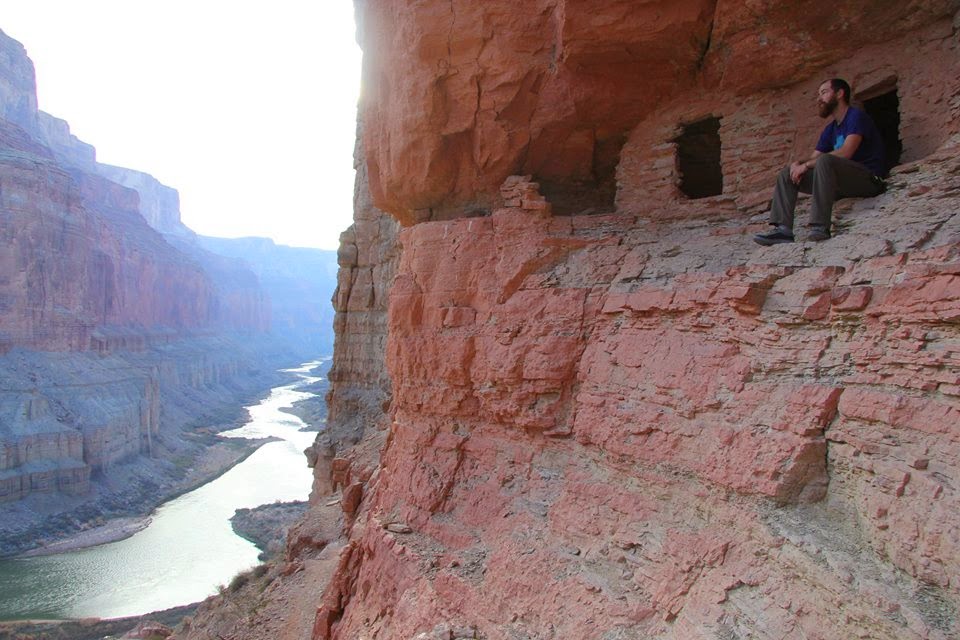
View of the Colorado River from the Nankoweap Granaries in the Grand Canyon (Photo: Jonathan Sisley)


A good number of ERGies would attest to having developed a deep environmental conscience from time spent in the wilderness. For many of us, whenever we are not buried in reading, writing, and problem sets, we are finding renewal through various outdoor adventures and activities. Fortunately for us, the Bay Area is situated pretty well whether you’re into mountains, forests, or the ocean. Or if you’re like me, you like to hang out in the Earth’s drainage ditches: rivers.


Taking the leap at Elves’ Chasm (Photo: Jonathan Sisley)


My passion for rivers led me to leave California over winter break and head to the biggest drainage ditch in the country: the Grand Canyon. Although permits to run the river are extremely competitive to win through the National Park Service (NPS) Lottery, the winners occasionally have to back out of their trips, freeing up their coveted permits. In these cases, the NPS issues "follow-up" lotteries, which tend to be less competitive (especially for river trips in the dead of winter around the holidays).

Through this process, a few friends and I were lucky enough to secure a Grand Canyon permit, which launched on December 19, 2014 (leaving barely enough time to finish my final exams!). We would be kayaking 279 miles in 13 days without raft support, meaning we had to cram 13+ days of food and gear into our kayaks. It is a big, committed trip--requiring a great deal of planning and preparation--from what food you’ll bring along to how you’ll go about packing your solid waste. I should have consulted with Emily (from my ERG cohort) for some creative ideas on my fecal sludge management! (See photo below.)


Kayaks loaded at the put-in (note the white PVC tubes - used to pack out human waste!) (Photo: Joseph Rand)


As I made the long drive from Berkeley to Lee’s Ferry--the put-in of the Grand Canyon--I reflected on what may be a slight contradiction in my values when it comes to my own carbon footprint: I willingly drive long distances in order to spend time in the wilderness. Here in Berkeley, I live a fairly efficient urban lifestyle and try to minimize my carbon impact. Admittedly, I do own a car, but it sits parked on the street for weeks at a time while I ride my bike everywhere (my steering wheel literally had cobwebs on it earlier this year). I, like all ERGies, consider it a part of my identity to live as efficiently and sustainably as I can.

Yet, here I am, driving over 2000 miles round-trip just to float down a river for two weeks. Is this carbon impact an acceptable trade-off for the enjoyment and renewal I expected from this adventure?

My close friend Josh--one of 3 other guys running the river with me--provoked these questions further. Just before leaving for the canyon, Josh graduated with an MS from the University of Michigan’s School of Natural Resources and Environment, where he studied grid integration of renewable energy. While floating down the river, Josh and I began discussing: How long would we have to spend in the Grand Canyon to balance the carbon impact of traveling there, compared to the baseline of our normal urban, energy consuming lifestyles? The assumption, of course, being that once we are in the Canyon, our carbon footprint drops to nearly zero (aside from food and cooking).


The group after hiking Deer Creek Narrows in the Grand Canyon (Photo: Jonathan Sisley)

Having taken Energy and Society (ER200) in the fall semester of 2014, I had gained the tools to do a simple back-of-the-envelope equation to attempt to answer this question! So, for the energy-nerds / wilderness lovers among us, here is a simple estimate of the number of days I would have to spend in the Grand Canyon to offset the CO2 emitted to get there in the first place.

A few key assumptions:
  • Food-related carbon emissions are the same in the Canyon as they are at home (let’s ignore the fact that I was eating around 5,000 calories per day in order to paddle 25-35 miles each day and stay warm!).
  • The round-trip journey to and from the Grand Canyon (including shuttling my car to the takeout at Pearce Ferry) was about 2,000 miles.
  • My car averages about 24 miles/gallon (the boat on top adds a lot of drag!).
  • I will use the EPA estimate that burning one gallon of automobile gasoline emits ~8,887 grams of CO2.
  • For my CO2 emissions here in California, I am assuming the average CO2 intensity of California’s electric grid to be 277 grams of CO2 per kilowatt-hour.

So how much CO2 did am I responsible for emitting based on this 2,000 mile drive?


Using a (very) crude energy audit based on a typical day here in Berkeley, I calculated my average daily CO2 emissions to be roughly 3.75 kg per day:

Energy audit
Energy audit

So how many days would I have to spend in the Grand Canyon in order to offset the CO2 emissions from driving there (compared to a baseline of a typical "Berkeley Day")?


Of course this is based on a lot of assumptions and rounding, but at least this number gives me a general ballpark idea. I was hoping for a smaller number--so hopefully whoever graded the ER200 problem sets can find an error in my calculations ;)

While I would LOVE to spend 198 days in the Grand Canyon, the maximum permit length is ~35 days. Next time I’ll just have to bring a few more ERGies along with me to the Canyon! Check out some more pictures and a short video from the trip below!

Camp at Lower Blacktail Canyon (Photo: Jonathan Sisley)


Hiking Deer Creek Narrows (Photo: Jonathan Sisley)


Scouting Lava Falls - Mile 179 in the Grand Canyon (Photo: Joseph Rand)


Joe scouting the crux move at Lava Falls, mile 179 in the Grand Canyon (Photo: Jonathan Sisley)

Dropping into Lava Falls - 30 seconds of chaos! (Photo: Joseph Rand)


Note: The views expressed here belong solely to the author of each entry and are not representative of the position of the Energy and Resources Group, UC Berkeley.

12.16.2014

[Alana Siegner, ERG MA]

Working on a school garden in Boston 

On a typical day walking to class, my eyes are caught by the sight of persimmon trees arching over the sidewalk offering their unusual fruits, small backyard gardens bursting over fences and property lines, and lime bushes camouflaging their green citrus offerings in a cloud of bright green leaves. Urban agriculture seems to be very much alive and well in Berkeley, especially by my East Coast-rooted standards. But, I believe there is more to the story than the superficial pleasure. I take in the fact that these food production centers exist; scattered among city and residential streets in the Bay Area. In my first semester out in California, I’ve made it a mission to learn more about and participate in the movement that is urban agriculture.

Me with some enormous collards from the Oxford Tract


My direct experiences in the urban agriculture scene have been universally positive; my research into policy and land use disputes has shown the controversial nature or flip-side of the urban-ag coin. Tuesday mornings at the Claremont Middle School garden in Oakland, and Friday mornings in the UC Berkeley Student Organic Garden (SOGA) often have me up to my elbows in compost, soil, or over-sized collard plants. I teach a weekly lesson in the Claremont garden to boisterous groups of 6 to 8th graders with the help of a volunteer garden manager who coordinates the garden lessons during an elective period at the school. The students at Claremont, as well as students I used to teach in Boston, have responded in meaningful and often hilarious ways to their first hands-on experiences with certain plants, which hopefully will make their way increasingly into school lunches.

I was inspired to explore more school garden projects in the area, and made it out to the Edible Schoolyard at MLK Middle School, the famous Alice Waters-backed project. The level of organization and productivity at that site was amazing: orderly rows of flowers and vegetables integrated into gazebo-like structures, a toolshed cleaner than my apartment, a wood-fired pizza oven, solar panels, and chickens wandering freely.
Also part of the Urban Garden Ecosystems class I’ve been taking this fall are the weekly lab sections in SOGA, where I’ve been learning the agroecological principles of soil building, intercropping, and seed starting. The harvest yields have often sent me back to ERG bearing trash bags full of basil, greens, and kale. These experiences led to the enthusiastic re-writing of the popular country song “Cruise,” as “baby you a song, you make me wanna roll my shirt sleeves up, and plant” -- a song my group and I performed at our final project presentation last week.

Chard harvest one day this Fall from SOGA


Behind these rosy experiences is a larger debate on competing land use claims -- development vs. environment. San Francisco made headlines earlier this fall for its trailblazing urban ag bill, AB 551, the Urban Agriculture Incentive Zones Act, but also for worsening the housing crisis with this policy. The author of the Atlantic Monthly article argues that urban agriculture on vacant lots is more appropriate to a city like Detroit, rather than SF where rent prices are sky-rocketing and there is a need for increased urban density; leave the gardens for the rooftops, he argues, not on developable lands. A controversy closer to home is the Gill tract redevelopment plans by the University. Starting in 2012, students and local organizers have been “occupying the farm” and arguing with the university over the proposed redevelopment of this land in Albany, part of a land-grant university system that they argue should become a center for urban agricultural research rather than a grocery store and affordable housing development. The fight for the land was featured in a recent documentary that premiered in Berkeley, “Occupy the Farm.”  

While these debates are far from settled, I believe decentralized centers of organic food production are the best way forward for building food security and resiliency in any community. As a solution to climate change, I see great potential in organic soil carbon sequestration, and eating locally grown produce reduces food-miles traveled that in turn reduces transportation-related emissions. I will continue arguing against the injustices of the current industrial food system, the consequences of eating a diet saturated by high-fructose corn syrup, and in favor of the merits of integrated systems like aquaponics structure. Growing food in small spaces, whether for a tiny home or urban restaurant like the soon-to-open Perennial restaurant in SF, is the way of the future.

A flower from the Spiral Gardens community gardening center


Some day my sister and I hope to open a farm-school where gardens and environmental education are center stage, where students learn in outdoor and real-world classrooms. We want to have lavender bushes, goats, and honeybees, among other things. Until that day comes, I will keep learning from urban farmers and tasting hybrid persimmon varieties at the Berkeley farmer’s market.


Note: The views expressed here belong solely to the author of each entry and are not representative of the position of the Energy and Resources Group, UC Berkeley.

2.13.2014

By Ben Mandel

Syncrude Aurora tar sands mine in Fort McMurray, Alberta (source: Greenpeace/Jiri Rezac)
[Note: Original post on February 1, 2014.]

On Friday, the U.S. State Department released its Environmental Impact Statement (EIS) for the proposed Keystone XL pipeline. Its central finding—that the project would have little impact on climate change—was a disappointment to many in the environmental community. After all, the project would bring dirty oil from the Alberta tar sands (see above) to the Gulf Coast of the United States and clear the way to an even more carbon-intensive energy future for the U.S. Back in June, President Obama pledged not to green-light the project unless it was found by the State Department not to “significantly exacerbate the problem of carbon pollution.” Some viewed Obama’s punting of the issue to Kerry as a good sign for pipeline opponents, while others viewed it as shrewd posturing. Now with the cat out of the bag, those who were suspicious of Obama’s stance are looking pretty smart.

But what gives? Isn’t it “bad” to facilitate demand for a dirtier commodity than what we currently use, much less the much cleaner non-fossil transportation fuels of the future? From one perspective, the ability to extract this oil is a marvel of modern technology—engineers wouldn’t have been able to even get at the stuff just a few years ago, before technology enabled its extraction from the thick tar sands. Seen differently, the need for advanced machinery to extract each barrel of crude adds significantly to its life-cycle carbon footprint. The EIS acknowledged the added greenhouse gas (GHG) burden of heavy tar sands crude relative to the lighter crude we generally refine in the U.S. today. In picture form, here’s what the difference looks like:
Incremental life-cycle emissions (middle stack) from comparing tar sands crude (rightmost stack) relative to the crude it would displace (leftmost stack) (source: U.S. Department of State)


In State’s words, here’s an idea of what these extra emissions amount to:
“The range of incremental GHG emissions [...] for crude oil that would be transported by the proposed Project is estimated to be 1.3 to 27.4 MMTCO2e annually. [...] This is equivalent to annual GHG emissions from combusting fuels in approximately 270,833 to 5,708,333 passenger vehicles, the CO2 emissions from combusting fuels used to provide the energy consumed by approximately 64,935 to 1,368,631 homes for 1 year, or the annual CO2 emissions of 0.4 to 7.8 coal fired power plants.”
Make no mistake about it—we’re talking about an especially polluting kind of oil here. State never could have credibly denied that fact. So State’s ultimate intimation that Keystone XL wouldn’t have a significant impact on climate (though the report is pretty careful to avoid making such a definitive statement outright) is therefore a question of what it’s been compared against.

In its analysis, the State Department assumes that if the Keystone XL petition is denied by the President, the tar sands oil—all 830,000 barrels per day of it—will simply find other ways of getting from point A (Alberta, though technically the tippy top of Montana) to point B (the Gulf Coast, though technically Nebraska or Oklahoma, where it can link up with existing pipes for the rest of the journey). In the pipeline’s absence, the report explores several “no-action alternatives” that involve some combination of rail and tanker transport of oil either directly to the Gulf Coast or to the existing pipe beginning in Oklahoma. The emissions from constructing the pipeline are dwarfed by the greater greenhouse gas releases from operation of any of the no-action alternatives, which require lots of fuel to transport the oil. By contrast, Keystone would require comparatively little fuel to operate. Looking at these alternatives, it’s easy to say that a pipeline makes the most climate sense.

But at the end of the day, as with most large-scale analyses, it’s all about assumptions. Embedded in the EIS analysis is the assumption that the Gulf Coast will get all of the oil the tar sands have to offer somehow. The market assessment deems it unlikely that the denial of Keystone’s petition would impede extraction efforts in Alberta. Even if this is true, how likely do we think it is that all 830,000 barrels per day make it to the Gulf Coast without the help of this pipeline? It’s difficult to assign a value here, admittedly, but State really ought to try. Because unless it’s a proven certainty that all the oil makes the trip regardless, the emissions from the no-action alternatives should be scaled by this probability to give us an idea of the expected value of emissions. For what it’s worth, a likelihood below about 80% begins to tilt the scale in favor of alternatives.

Without an extensive and efficient pipeline with pretty low operating costs, it would become pretty costly to get one’s hands on tar sands oil. And the U.S. isn’t short on other options, at least not yet. Why would we still insist on getting our oil fix from Alberta in such a scenario? If the tar sands oil flows without having Keystone as its outlet, I’m guessing it goes to other countries. To me that means that less than 80% of full-scale tar sands production would end up in Gulf Coast refineries without Keystone.

Secretary of State John Kerry now faces the decision of how to interpret this report, and ultimately how to act on it. He could take his chances that tar sands oil production would falter without the pipeline to prop it up, and opt to reject the petition. But now that the EIS has materialized, Kerry can’t take an overly activist stance that would undermine his own department’s credibility. More likely is that Kerry is bound by State’s assumptions regarding ugly no-action alternatives, and approves the petition. And maybe that won’t be the end of the world; some have suggested that Keystone opposition is a costly way to spend scarce political will for the environmental cause anyway.

I’m guessing we’ll get the chance to find out.

Crosspost from The Big Word Blog.


The views expressed here belong solely to the author of this entry and are not representative of the position of the Energy and Resources Group, UC Berkeley.
 
© ERG. Design adapted from Main-Blogger Blogger Template.