Showing posts with label Farm to School. Show all posts

9.23.2015

[Alana Siegner, ERG graduate student] 


Volunteer Harvest Days (Siegner)

These people I’ve been surrounded by this past summer have taught me to believe in my goals for the future (“How’re you gonna have a dream come true if you don’t have a dream?” my farmer Doug likes to say); they’ve taught me to better articulate my current research aims; to build relationships with people of all ages; to appreciate and learn from natural beauty; to communicate well; and to express gratitude openly.

During the months of June and July, and for a week in August, I’ve been working on a small organic vegetable farm on Lopez Island, off the coast of Washington State.

Sweetbriar Farm Stand Saturdays (Siegner)

Lopez is a small island of about 2,500 permanent residents, and its 29.5 square miles are predominantly agricultural. It is known for farming and for the “Lopez Wave” exchanged between passing motorists. For someone studying sustainable agriculture and farm-to-school programs, Lopez is an ideal place to spend a few months sans textbooks and problem sets -- immersed in the farming lifestyle.

I developed many concrete skills while living and working on Lopez: how to drive a tractor and backhoe, how to set up drip irrigation systems, how to use an array of different weeding tools, how to properly maintain compost piles, and how to water different types of plants. I also gained conceptual knowledge I’d been lacking: how many gallons of water are required for 3 acres of veggies per day using drip vs. sprinkler systems (about 10 times less); how to attract native pollinators; best practices for rebuilding soil health and promoting soil carbon storage; the economics of small farms; and the benefits of growing many varieties of each plant (we grew 13 varieties of lettuce and over 20 heirloom varieties of tomatoes).

Laney haying with the backhoe (Siegner)

I worked at the Sweetbriar Farm 3 days a week, walking the fields alongside Doug each morning at 7 am as we made a work plan for the day, and cooking meals with Tamara most evenings. We planted over 5,000 row-feet of veggies while I was there. I worked at the Lopez School 2 days a week, helping the garden managers run the farm to school program in the summer months while students are out of school. The kids do a lot of work on the ½ acre farm and orchard during the school year, planting, weeding and harvesting over 6,000 lbs of produce, which goes straight into their cafeteria lunches. During the summer months, Suzanne and Valeri keep up the good work with help from occasional interns.

In addition to harvesting and planting for the fall, we fixed the irrigation system, built new planting areas, and put up lots of food in the kitchen, preserving for the school year food items like pesto, veggie roasts, hot pepper relish, raspberries, and tomato sauce.

Tomatoes at the school greenhouse (Siegner)


Aside from these “hard” skills gained from working with my hands, I found my two months on Lopez most transformative because of the softer skills I developed from working in such a sustainable, waste-water-and-energy conscious, close-knit community.

The people I met were very open to conversation about whatever it was that they did on Lopez, and with most people it was at least 4 different things. Someone might volunteer at The Dump (the award-winning recycling facility on the island), teach at the school, run a B&B, and sell their copper crafts at the Farmer’s Market each weekend. Or they may operate a goat dairy, play the fiddle at island square dances, keep bees, and write for the island blog, Project 468.

ERG alumni Chris and Chom Greacen, part of the Lopez community, travel regularly to Southeast Asia, collect signatures for the WA 732 Initiative to institute a carbon tax in WA state, maintain a thriving home garden, raise 2 kids, live in a (soon to be certified) net zero energy home, and when I arrived were eating a 100% local Lopez diet.

Common Ground community, an affordable housing community working towards net-zero status, where Chris and Chom Greacen live (Siegner)

A union of the “soft” and “hard” skillsets of Lopez came out in my running friend Diana’s statement that summarizes the attitude of many Lopezians: “I like to move my body in nature and experience this feeding of my soul.”

Aldo Leopold, too, articulated a mental and physical union of sorts in his concept of a “land ethic.” By combining actions and beliefs into an environmental lifestyle, a healthier, more resilient world is possible. By following the Lopez example of working with the land rather than against it, in combination with a thriving sense of civic engagement and community wellbeing, a more sustainable, environmentally restorative food system results.
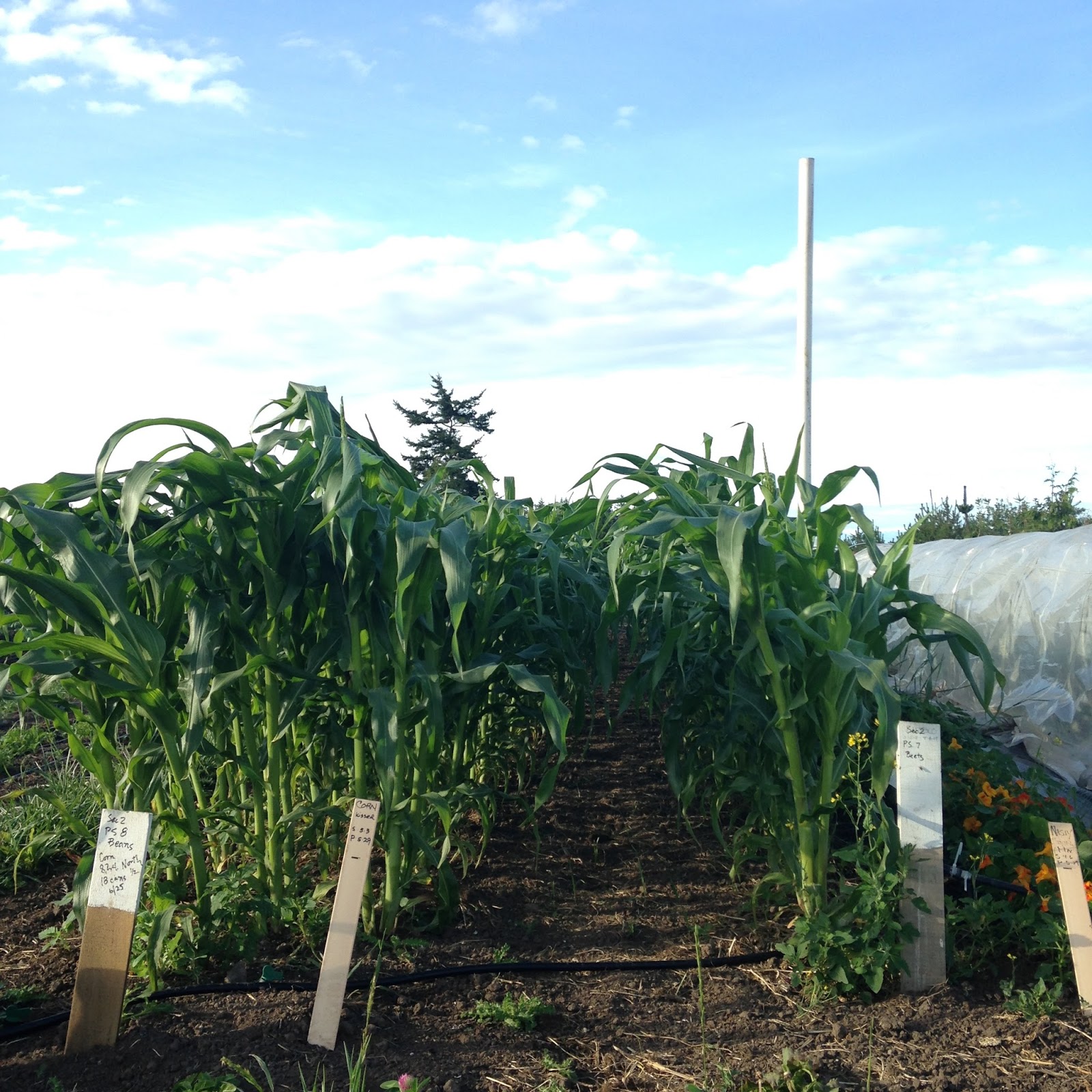
The corn grows (Siegner)


Note: The views expressed here belong solely to the author of each entry and are not representative of the position of the Energy and Resources Group, UC Berkeley.

5.14.2015

[Laney Siegner, ERG graduate student]

“Only in the past decade has farm to school emerged as a movement to change the way children understand food and to offer farmers new markets for what they produce.” (Beery & Joshi, 2012) 

Tasting reception at Monterrey High School featuring food produced by participating districts in the California Thursdays initiative.

At the Asilomar Conference Grounds, there was a palpable excitement for those present of being in rooms full of farm to school enthusiasts. Although hailing from a variety of backgrounds and job titles (teachers, farmers, school administrators, food service directors, school “chefs,” non-profit leaders, school board members, parent volunteers, and academic researchers), all were enthusiastic about the premise of providing real, healthy food to schools from local farms.

The Farm to School program in California currently involves over 85 school districts, of which Berkeley Unified School District was the first district in the country to pass a progressive food policy recognizing the connection between healthy eating and effective learning. On May 4-6, 2015, over 250 California “first responders” to the national health care crisis convened in Pacific Grove, CA for a state-level Farm to School conference.

Conference attendees were encouraged to take a "holistic view" of how fresh produce contributes to school curriculum and education. Laney is the corn with the tennis racket on the left.

Sam Farr, Democratic Congressman from California, delivered opening remarks asserting that the crew gathered before him were first responders in the sense that providing healthy food grown on local farms to students in school was a fundamental strategy for reducing childhood obesity and the associated lifetime health care costs that put such a strain on the national system. From an ERGie perspective, I am used to hearing such interdisciplinary analyses of the benefits of a particular program like Farm to School. This was just the first in a series of frames placed around Farm to School programs, from health and nutrition to environmentalism, to climate change, and improved math and science education.

... it is important to note a central theme of the conference: the need to more rigorously evaluate programs consistently across districts and states...
This basic idea of farm to school has become “revolutionary” thanks to the modern industrial food system, a huge source of greenhouse gas emissions (due to transportation, concentrated animal waste streams, land use change, and chemical fertilizer inputs) environmental degradation and adverse human health outcomes. Not to mention the loss of aspects of culture associated with the loss of small farms and farmers as a way of life in this country. Issues of food are issues of culture: food is what we are and want to be. If we want to be diverse, full of variety, connected, healthy, and environmentally “literate,” than our food system has to be those things first.

As a means to promote biodiversity, local economic development, social justice, secondary education, and environmental and human health, school gardens or farm-to-school programs are pretty compelling solutions to contemplate. They hit so many targets with one arrow. However, before getting too carried away with the idea, it is important to note a central theme of the conference: the need to more rigorously evaluate programs consistently across districts and states; the need to collect numerical data year after year, and the need to move beyond anecdotal “success stories” towards scientifically driven empirical results necessary to secure sustainable funding for such programs.

CA Thursdays is an initiative started by the Center for Ecoliteracy in Berkeley. 

It is my hope, as a researcher and former educator, that Farm-to-School can be embedded as part of a holistic approach to secondary school reform. According to the “3 pillars” of the U.S. Green Ribbon School award program, schools must meet building, operations, and curriculum standards in greening their school. To meet these criteria, for example, cafeteria food might be procured from local farms and supplemented by an on-site garden-classroom; the school implements energy efficiency and waste recycling/reduction measures in buildings; and the curriculum across subjects is reflective of the realities of climate change and today’s environmental problems,

To see what some schools have been on to with Farm to School programs, conference participants were invited to Monterey High School for a “California Thursdays” tasting reception of what local school districts are offering to their students. The California Thursdays initiative was created by the Center for Ecoliteracy and piloted in Oakland Unified School District; currently 42 districts participate in serving meals sourced from California ingredients on that day of the week (totaling over 250 million meals annually).

The results were impressive, colorful, and delicious; a promising sign of things to come in building the world we want the next generation to inherit. For more info on CA Farm to School programs, policy initiatives, and resources for schools, go to http://www.farmtoschool.org/our-network/California.


Note: The views expressed here belong solely to the author of each entry and are not representative of the position of the Energy and Resources Group, UC Berkeley.

 
© ERG. Design adapted from Main-Blogger Blogger Template.