Showing posts with label climate change. Show all posts

9.11.2018

[Laney Siegner, ERG graduate student]

Yoga at Grand Central Bridge outside Nome, AK. Photo credit: Ori Chafe

“You’ve been lucky with the weather, that’s for sure,” the woman said. “Last summer it was raining every day this time of year. Follows a low-snow winter. Last winter was a big snow year, so this summer has been nicer weather. Good thing you’re leaving before the rains really set in -- all of October and November will be cold and drenching rains. Used to be we’d have snow by Halloween, but these days it’s more like December that we’re getting the first snows.”

Conversations about the weather fill the small, cozy room in Pingo Bakery and Seafood café. The weather is never far from an Alaskan’s mind. Here in Nome, an outpost of the Seward Peninsula on the Bering Sea, everyone has noticed the striking pace of the weather’s change over the years, from later snows to earlier thaws to more dramatic rains. Climate change is openly acknowledged by many, including Alaska’s Republican senator Lisa Murkowski. But the state is simultaneously lamenting the problem, searching for solutions, and supporting oil and gas drilling, the building blocks of the state’s economy. It is a place that is experiencing the direct impacts of climate change most rapidly and still struggling to implement solutions.

I came up to Nome, a major destination of the Yukon Gold Rush and finish line of the Iditarod dog sled race, to assist with ongoing research into the changing dynamics of the Arctic ecosystem. The project is a collaboration of several academic institutions and national labs and aims to inform climate models with better information about Arctic plant communities, ecosystem processes, and feedbacks. I spent the last week of August traveling out into the tussock tundra landscape to count shrub seedlings and take soil microclimate data from several plots 70 to 80 miles outside of Nome.

Driving down the dirt roads out of town each day afforded ample opportunity to observe and learn about the natural history of Alaska’s North Slope, a land of extremes dominated by shrub and grass plant communities north of the tree line. We observed solifluction lobes, creeping lumps of soil on hillslopes reflecting differential downhill flow rates of glacial deposits, sorted circles of rocks left behind by the last glaciation, and pingos, mounds of earth-covered ice from drained lakebeds. We also witnessed rough-legged hawks swooping across the road, a red fox roaming along a river bank, and a wild musk ox herd grazing on the grasses. The musk ox hair, qiviut, is prized for its strength and water resistance and is incredibly soft, a great source of extra insulation in jacket pockets when found in the field.

The first three days we visited plots near Quartz Creek to count how many birch, alder, and willow seedlings had come up since being seeded in June. We also took soil cores, temperature measurements, soil moisture, and vegetation measurements at each plot. The depth to the permafrost layer, between 50-70 cm in most of my measurements, is growing as permafrost warms. This causes all sorts of problems: pools of water at the surface, soil collapse, changing water flow paths, and release of carbon (primarily methane or CO2, depending on whether the soil is wet or dry). The research team is gathering data in the amount and form of carbon released.

Traversing the tussocks to access the field plots takes some getting used to. You’re either stepping around the tussocks into some mystery sinkhole, or on top of them if they’re large and stable enough to support a boot. Rainboots and rain pants are key to navigating a boggy crossing, with water rising to knee height. It’s a good leg workout, rewarded with ripe alpine blueberries all around us for snacking. Colors are changing already. The birch leaves turn from green to orange, yellow, and red, and the tones of fall grow more pronounced each day. Change happens fast, this far north.

In the evenings in Nome, the days seem endless with light stretching on towards midnight. We had to draw thick curtains over the windows to get some rest. On the flip side, we woke in the dark, as the sunrise didn’t strike the horizon until around 8 am. I read up on the natural history of the region, whaling, and climate change research before bed, appreciative of the context to put all the information into perspective.

The last day in the field, we drove down a different road towards the town of Council, a community of mostly summer homes (there is one year-round resident) situated to the east of Nome. At the end of the road, residents must drive through the riverbed to access the houses across the river, assuming the river level is navigable. Like many communities along the water, boats are increasingly necessary to access the homes. We traveled along the coast of the Bering Sea before turning inland, where hilly tundra terrain replaced the vibrant green wetlands. White spruce trees became occasional as we approached the tree line. There was a last grove of spruce trees in a line right by the field site.

We took greenhouse gas emissions of twenty plots in the area using a portable gas analyzer, a remarkable piece of technology that gives measurements of CO2 and methane in real time. It is still in want of some features, such as reporting of its battery SOC, a shorter warm-up time, and more consistent calibration, but is nevertheless impressive in what it can do. We took CO2 and methane readings within a clear chamber, to measure net flux, and an opaque chamber, to capture soil and plant respiration without photosynthesis. This was a fascinating process to observe as it may also be relevant to my agricultural research and prospective future projects in which I may measure emissions from sites treated with compost, biochar, or both.

I spent my last morning in Nome running along the beach, observing the gold dredging equipment and ships out at sea on a cloudy, cool late summer morning. I went to Pingo to warm up with coffee and the largest cinnamon roll I’ve ever been served. I shared in more conversations about the weather with a waitress who just moved in June to Nome from Mississippi. She seemed sanguine about facing her first winter here and pleased with her new home. She had followed her wife up here who had gotten a job as a nurse, and wasn’t looking back.

As we talked about Alaska, Mississippi, and my home in Washington, D.C., I gained a real appreciation for the cultural and geographic diversity of this country. The range of ecosystems is extreme, from tundra to tropical coastline. Learning firsthand about the human reactions to life in such places motivates me to continue my work as a climate researcher and educator and keep building knowledge about climate narratives and science.

Burned tussock tundra

Sorted Circles left by last glaciation

Wild musk ox on the tussock tundra

Building on Nome's Front Street covered in west-facing solar panels

Nome at 10:30PM

Town of Council across the river

Nome beachfront on the Bering Sea

Views of the Bendlebens in clouds

Rainbow on the way to Quartz Creek

Last train to nowhere

11.17.2017

[Gordon Bauer, ERG graduate student]

The northern lights outside Barrow. Photo credit: Ori Chafe.

A few weeks ago, ERG Professor Margaret Torn sent a cryptic department-wide email inquiring if anyone would like to assist in ecological research in northern Alaska as part of the Next Generation Emerging Ecosystems – Arctic project. I thought for a few moments about how disruptive and inconvenient this would be: two days lost in transit, foregone work time with deadlines fast approaching, and evenings spent alone in an icy wasteland. Then I thought about opportunities that only come once in a lifetime, and impulsively sent out an emphatic yes. One thing led to another, and then suddenly I found myself in a taxi to the airport at 4am, bound for Barrow, Alaska on the shores of the Arctic Ocean.

“The sea has given us so many gifts…it can have my body.” My main motivation for going to the Arctic was the physical place: I wanted to experience the icy landscape extending as far as the eye can see, the northern sun low in the sky, and the chance to see polar bears, arctic foxes, and the aurora borealis. I was not disappointed. On our second night in Barrow, we laid in a snowbank for over an hour with approximately 50 layers of clothing to protect against the polar wind, staring in awe as giant green ghosts danced across the sky. At one point an arctic fox scampered by, pausing to ponder what we were doing there. On the third day it snowed, and the Arctic Ocean turned into a giant slushie, the waves barely strong enough to break.

The work itself was a refreshing break from the office: every morning, we snowmobiled out to a field site in the tundra in the pre-dawn 10am light, dismantled frozen monitoring equipment for a few hours, and then transported it to a warehouse via sled as the sun set around 3pm. For the past five years, this equipment has been used to take incredibly detailed measurements of the arctic ecosystem and the evolving interactions between the ecosystem and climate. Among other things, an eddy flux tower measures carbon dioxide and methane released from the melting permafrost, while an elevated tram system measures changes in flora and energy balance along a 40-meter cross section. The monitoring station is dismantled for the winter every November, and set up again in the spring.


Ori Chafe (right) and Stan Wulschlegger take sensors off the eddy flux tower, as ERGie Richard Barnes (left) looks on.

Richard packs up equipment for the winter.

The daily commute.

Ori (left) and Richard enjoy some Arctic pumpkin pie.


However, what I found most fascinating and inspiring about Barrow was not the science nor the landscape, but the community itself. A hub of Inupiaq culture and one of the few places in North America with active whale hunting (bowhead whales serve as a crucial source of food for the community), Barrow feels at once foreign and utterly American. On our second night in Barrow, I drove into town with Richard Barnes—my ERG companion on the trip—to take in the sights. In many ways, Barrow looks like any other small American town, with a few key differences. The wooden homes are all on stilts to maintain stability during permafrost melt, and outside the mayor’s office on the main street sits a bowhead whale skull the size of a small car.


Richard admiring the lawn decoration outside the Barrow mayor’s office.

The Arctic Hotel in Barrow.

When Brussel sprouts are $6.99/lb, vegetarianism isn’t the most practical option.


“When someone says they support 'America first,' you have to wonder, does the America they are talking about include Barrow, Alaska?” Sadly, that arctic environment is changing rapidly, and it isn’t clear how much longer Barrow will continue to exist in its current location. As the sea ice melts earlier in the spring and takes longer to form in the fall, the waves have more time to erode the land. The flooding has become a serious problem. Already, residents have had to relocate some ancestral grave sites, and many fishing cabins outside of town have been swept away. Within the next 20 years, it is possible that all of Barrow will have to move. But in the face of inevitable destruction, we also saw signs of resilience. When we talked about the need to relocate graves, one woman we met said, “The sea has given us so many gifts…it can have my body.” She spoke with excitement about relocating to a village in the mountains.

My visit to Barrow was a strong reminder of the diversity of this crazy country we call home, and of the fragility of life at the frontier. When someone says they support “America first,” you have to wonder, does the America they are talking about include Barrow, Alaska? If so, supporting America first means supporting a diversity of cultures and world views. It means supporting not just a way of life associated with coal mining, but one associated with whaling, frozen tundra, and polar ice caps as well. Perhaps above all, supporting America first means doing all we can to stop climate change.


10.12.2017

[Michelle Levinson, ERG Graduate Student]

Image Source: East Bay Times

This has been a terrifying year. Earthquakes, hurricanes, heat waves, and floods — the news sounds like a chapter from the Book of Revelation, or a scene from the dystopian future that Octavia Butler envisioned 25 years ago. We know that these traumas and calamities are experienced first and worst by those with the fewest resources and means for resilience, and this truth has played out in the varied impacts of storm flooding in HoustonPuerto Rico, and Bangladesh.

I have read articles and “reacted” to posts on social media; I have donated (grad-school-budget-sized amounts) to causes; I’ve traded updates and insights with family, friends, and random strangers. Yet while these disasters have caught my attention, I have primarily managed them on the rational side of my mind — acknowledging all of this loss, but also wondering what I would have for lunch and whether the 6-bus would be running on time. This is to say, the remote traumas of others stayed emotionally remote to me, and I think to many others as well.

Disaster elicited a very different and emotional reaction this week, after landing so much closer to home. On Sunday morning, I woke up to a string of texts among my family. My aunt and uncle had been evacuated from their home at 2 AM the night before. They awoke to a loud banging on the door and saw the hills above them glowing orange. Now they are with my family in Oakland, still waiting to learn the fate of their home. Many have not been so lucky.

This tragedy reaches deep into the ERG and Berkeley communities, though the fires rage two counties away. It is not just the immediate loss of life, home, and community that we mourn, but also the little things we take for granted. For me, this is my bicycle commute.

Wednesday morning I checked the air quality and decided that 73 AQI was good enough to ride my bike to school. Maybe I would go a bit more slowly than usual, but I had my inhaler in my backpack (as always) and was desperate for some exercise to release some of the stress of midterm season. After all, I make this ride multiple times a week and am in pretty good shape. On a normal day, I don’t even need to puff my inhaler before going on a jog.

But five minutes into my forty-minute ride, I knew something was wrong. There weren’t many other cyclists on the street, which was abnormal. I pedaled past an unusual number of babies and children waiting with their guardians to cross the street to the pediatrics unit of Kaiser Permanente. By the time I was two miles into my five-and-a-half-mile ride, I was very short of breath.

For me, an asthmatic episode comes on slowly, straining my breathing and then constricting my chest in the way you might feel right before you start to cry. Yet the instinct to take a deep breath to calm myself and reset leaves me even more scarce for air. In these moments, it is hard not to let your thoughts rush and fear mount, but nerves are far more hurtful than helpful. In fact, it is because my asthma is so well managed that I am unfamiliar with handling the symptoms when they do arise. I am privileged to always have had access to quality healthcare, but my experience is common among children that grew up in Oakland.

I would rather that experiences like this stay rare, but I am not deluded. The effects of climate change are projected to increase prevalence of asthma triggers, like longer pollination seasons and ground-level ozone. As this week’s tragic events in the North Bay attest, fires are another awful face of these threats, driven in part by climate change. Whether it is the asthma attack of a cyclist in Oakland or the tragedy of losing your home in Santa Rosa, the havoc of climate change has come home.

I am proud to be a member of the ERG community. We have the opportunity, and the obligation, to apply our training, knowledge, and skills to this great challenge whose consequences are known too well, both near and far. Today, we also urge you to consider volunteering or donating to support the communities in the North Bay, and throughout California, that have been ravaged by fire this October.


Thanks to Jesse Strecker for his thoughtful comments on an early draft of this post.
Note: The views expressed here belong solely to the author of each entry and are not representative of the position of the Energy and Resources Group, UC Berkeley.

11.24.2015

[by Jessica Reilly, ERG Ph.D. student] 

“We need to jibe now!” I yell as an animal the size of our 39-foot sailboat crashes into the water a few feet off our starboard beam.

ERG graduate student Jess Reilly and partner Josh Moman aboard their research sailboat, Oleada

We’re sailing in open water in the Pacific Ocean, off the west coast of Mexico’s Baja peninsula. The wind is blowing a steady twenty knots out of the north, and the boat surfs down rolling five foot ocean swells. But a frisky humpback whale just moved two-thirds of its 70,000 pounds out of the water and into the air—a dumbfounding event that also spells trouble for our boat in the middle of the sea. Crashing with a distracted whale flying through the air is one of our many potential dangers out here.

My partner Josh and I manage to quickly jibe (move the sails from one side of the boat to the other with the wind at our back,) and skirt the breaching whale. We are on our way to Isla Cedros, about halfway down the Baja peninsula. After sailing through the night, we finally “drop the hook” (set our anchor) on the island’s rugged east side.

A view from an unnamed canyon on Isla Cedros back to our boat, Oleada. The name means wave, swell, or uprising

As we sit in the cockpit in the sun, a bright yellow panga motors into view from the north. A panga is an open boat with an outboard engine, designed by Yamaha in the 1960s to give fishermen access to shallow water while still tough enough to ride over ocean chop. The panga before us is piled four-deep with lobster traps. The fisherman standing at the back motors over and we start to chat.

I learn that this man, Eduardo, has fished here seasonally for twenty-seven years. The racket of elephant seals barking and screaming on the island continues, and Eduardo comments that this is the first year that the elephant seals have come to this part of the island. His style is thoughtful, pensive.

A curious visitor to the boat on Cedros

Since he has seen this island and its changes for a while, my interest is piqued. Without any leading words like “weather” or “climate,” I ask, is it different now here, or the same?

He turns his eyes to the sky and purses his lips, carefully considering my question. I lean forward.

Narrowing his eyes, he replies, “Different.”

“There are far fewer lobster now,” he says. “This year, from the effects of El Niño, the water is warmer, which is good for lobster, but generally there are far fewer now.”

His gaze stretches to the shore as he speaks, sifting through his memory. “Much has changed,” he continues. “For example, in 1997, there were three kinds of abalone: white, red, and black. That winter we had an El Niño, and the black—they disappeared.”

“Disappeared?” I respond, surprised.

“Completely,” he answers.

We chat more about life on the island, then he putters slowly away. With only a few simple questions, this man tied to the cycles of climate and weather recalled the changes to which he needed to adapt.

Pangas anchored in the harbor at the only town on Isla Cedro

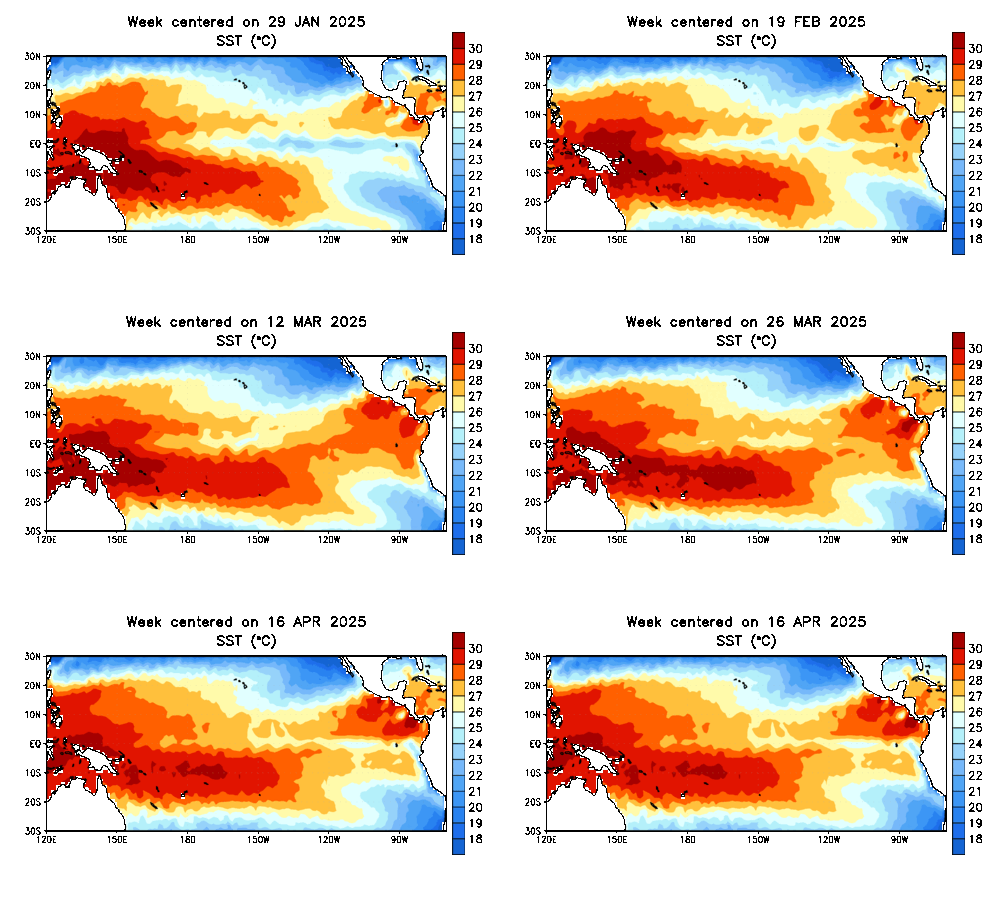
So what happened to the black abalone? To Eduardo, the abalone disappeared because of El Niño, the weather phenomenon created by warmer-than-usual water in the Pacific at the equator. Peruvian fishermen noticed the warm water around Christmas in the late 1800s, thus naming it “El Niño” after the baby Jesus. In 1997, El Niño was credited with disastrous hurricanes in the Pacific and a horrendous winter for northeastern North America, among other weather challenges.

El Niño is a natural phenomenon, but climate change drives the frequency and severity of El Niños. Here’s how this works: the ocean is a lot of water (H2O), absorbed carbon dioxide (CO2) and heat (energy!), and it has been absorbing over 90% of the extra carbon dioxide and heat we humans have added to the atmosphere since 1955 (we went from 280 parts per million of CO2 to 401 ppm today.) If you add heat and/or carbon dioxide to water, it expands. When we're talking about a lot of water, like the Pacific, the heat becomes energy in the form of currents, eddies, and storms.

Hurricanes gain strength with the constant heat and moisture from open water, and they start to lose their energy once over land, in part because they can no longer draw warmth (energy) from the ocean. The hurricane season therefore ends as the water cools for the winter in both the Pacific and the Atlantic. But El Niño keeps the water warmer longer in the Pacific, and this has a global weather (energy) impact.

NOAA, the National Oceanic and Atmospheric Administration, declared in April that El Niño is officially here for 2015—although Eduardo could have told us that back in December, because he was seeing more lobsters and fewer big fish. Back in 1997, he also knew the fishery was different and the water was warmer, and, it seemed to him, a permanent change occurred as the result of that difference.

If you look up the cause of the mortality of the black abalone, you find Withering syndrome, a bacterial infection that causes the foot of the abalone to shrink, thus making it unable to cling to a rock. For this reason, the black abalone is globally listed as critically endangered. So was it just coincidental that they disappeared from Cedros during El Niño?

The magically iridescent interior of a red abalone, a species still harvested in Baja

As with many diagnoses, the answer is more complex than one cause. Black abalone can live in harmony with this bacteria—it doesn’t affect them. However, as soon as the water warms up even a little bit, they are overcome by this bacteria. Therefore, the abalone at Cedros may have been living with the bacteria, but a rise in ocean water temperature—less than four degrees Farenheit—brought about their collapse. Like a murder mystery, the bacteria is the smoking gun, but it was El Niño that pulled the trigger—and Eduardo lives in the neighborhood and can testify as a witness.

Scientists are calling this year’s El Niño “Godzilla,” and compare it to 1997. Already record number and intensity of hurricanes have occurred in the Pacific as the water warms. These changes impact not only the small abalone or the individual fishers like Eduardo, but the largest mammals ever to live on earth: whales. In warmer, nutrient-poor water, whales, like the one we saw breaching in the Pacific, struggle to find enough food. Whether or not we see them, the whales still exist under the surface, adapting or suffering with change.

From CPC

Much of the time, changes in climate are hidden from everyday view and our lives continue without a breach. But once in a while, these changes explode to the surface to disrupt our view, crashing down with an enormous splash. Indications of these changes are lived and breathed by Eduardo and others who live tied to the coast. We can listen to their observations and take heed of their accounts of the sudden or long-term change. We can learn how to adapt nimbly and with care for our resources. But we must always be on deck to scan the horizon for these events. Eduardo is standing watch at the helm—we just have to listen.

Although I didn’t get a photo of Eduardo, I caught this shot of Don Jose in La Paz. He’s a lifelong fisherman who used to fish by sail. His stories of changes over time have real meaning for the scientific community

For more on Jessica's posts on the sea, go to her personal website Sailing for Climate here.

Note: The views expressed here belong solely to the author of each entry and are not representative of the position of the Energy and Resources Group, UC Berkeley.

8.07.2014

[by Nkiruka Avila, EDFCC Fellow at PerkinElmer & ERG Graduate Student]  

EDF engagement manager Serena Mau and EDF Climate Corps fellow Nkiruka Avila during a tour of the PerkinElmer Fab.
Energy efficiency is an essential part of climate change mitigation, which is my primary motivation for becoming an Environmental Defense Fund Climate Corps fellow. My goal is to find energy and water savings at my host organization PerkinElmer in Santa Clara, California. PerkinElmer designs and manufactures medical imaging technology that tackles the world’s most critical health related challenges.

The facility I am working in this summer has a class 100 clean room (we call it “the Fab”) where 50x50 cm digital flat panel x-ray detectors are fabricated. Any impurity in the Fab could cause defects in the panels. PerkinElmer’s fabrication process is unique because each of the panels produced is kept as a whole unit and is not cut into smaller pieces. This makes it critical to produce flawless panels every time as a defect could ruin the whole panel.

Recently, I took a tour of the Fab with my supervisor Joe Batdorf and my EDF engagement manager Serena Mau. The tour of the Fab was fascinating and revealed just how energy intensive the fabrication process is. I was impressed to see that several energy efficiency projects, headed by my supervisor, had already been implemented at the facility. Energy efficiency is not a foreign idea to PerkinElmer and they have invested in several energy saving measures over the years.  For example, PerkinElmer completed a reheat coil optimization project and replaced two inefficient boilers with efficient condensing boilers saving almost 70,000 therms of natural gas annually and eliminating over 300 tons of carbon emissions.

Despite the implementation of several energy efficiency measures, there is still room for more. I am working on proposing further energy efficient lighting, computer power management software and other energy saving measures for the air compressors and fume scrubbers in the facility. Silicon Valley Power offers great resources like lighting audits to help identify potential rebates. I am also investigating water conservation measures for a reverse osmosis system and two fume scrubbers that have the potential to save three million gallons of water annually. With California’s drought, these water conservation measures are direly needed.

Being an EDF Climate Corps fellow has given me the opportunity to learn about energy efficiency solutions and their financial and political obstacles. I am learning about the many incentives offered by the state and local governments in California to promote energy sustainability. EDF Climate Corps has also opened up to me a vast network of professionals and students working towards a more sustainable future. The experience is invaluable and substantiates my intuition that my work is headed in the right direction.

Crosspost from EDF Climate Corps.


Note: The views expressed here belong solely to the author of each entry and are not representative of the position of the Energy and Resources Group, UC Berkeley.

2.24.2014

By Jess Reilly

Thanks to the recent dedication of the Ivanpah Solar Electric Generating System (ISEGS), the corresponding scathing article in the Wall Street Journal, and Dan Kammen and Tonio Buonassisi’s appearance on NPR’s On Point, Ivanpah and solar energy in general has been back in the news.

Tortoise at Ivanpah (J. Reilly)
ISEGS is a concentrating solar plant (CSP) driven by technology from BrightSource Energy: it uses mirrors to reflect the sun’s light to the top of tower, where the heat turns water to steam. This steam then turns a turbine and generates electricity. CSP has the added benefit of heating a salt medium that can store the heat with minimal losses. Therefore, the plant can provide electricity to the grid not only during the day when the sun is shining, but at night as well. This storage reduces the intermittency of the CSP energy supply and allows the plant to compete with other ‘baseload’ energy supplies like coal and natural gas.

ISEGS happens to be the largest example of concentrating solar in the world, with 360,000 garage-door-sized mirrors and three giant towers sprawled over 5 square miles of Mojave desert. It generates electricity just north of Interstate 5 at the Nevada-California line and transmits to southern California.

Burrow excavation at Ivanpah (J. Reilly)
I walked nearly every inch of those five miles when I worked as a biologist at ISEGS. I was there from the moment the first bulldozer broke ground in the Ivanpah Valley in 2010, under the regal summit of Clark Mountain, until I came to ERG as a graduate student in the fall of 2012.

Ivanpah (J. Reilly)
I returned to graduate school in large part because I could not stand to supervise the destruction of the desert anymore. Having lived and worked in this fragile and biologically diverse desert since 2001, I watched my backyard plowed under for energy that would feed the demand of 140,000 homes hundreds of miles to the west. It did not seem environmentally or socially equitable. After living and working in the Ivanpah valley for two years, I promised this valley I would not let it be further destroyed, and I went back to school to figure out how to protect it.

Here’s what I have discovered:

Solar power protects Ivanpah Valley.

Horned lizard at Ivanpah (J. Reilly)
This is not to say that Ivanpah got it right. I was witness to painful foibles throughout the process as it stumbled forward. It has been a learning experience for everyone involved, from federal agencies to technology innovators.

Yet the very plant that displaced hundreds of tortoises may be the very thing that will save these individuals, their species, and ours.

An energy system built with renewables is necessary if the Mojave desert ecosystem, including the desert tortoise and all its migratory birds, are to survive into the coming generations. Previously, I did not fully understand the implications of a grid that continues to rely on fossil fuels.  But at 400 ppm of heat-trapping carbon dioxide and rising, many habitats and backyards are changing. Global sea level rise is now almost 7 inches higher than pre-industrial times, with the rate of increase today nearly double that of the last century. The extent and thickness of sea ice has dropped dramatically. Glaciers are retreating, and cities that rely on their consistent water supply are looking into a near future where they have no water for their millions of inhabitants.

Kangaroo rat at Ivanpah (J. Reilly)
Therefore, utility-scale CSP is an effective way to bring renewable energy online right now, in tandem with rooftop photovoltaic solar and other renewable technology. In addition, stumbles at Ivanpah have provided the agencies and the industry with the experience for doing things better in the future, and a paper that thoroughly details these possibilities can be found here. In addition to wildlife impacts, solar energy can consume water resources, increase particulate matter in air, and have an unknown impact on soil carbon (sequestration of carbon in soil and rock.)  Yet even this article addresses the cobenefits that the BLM and companies such as BrightSource have learned:

  • we can use degraded land and avoid pristine habitat
  • we can co-locate energy with agriculture and other renewable technology
  • we can carefully address siting with each individual project with thorough consideration given to local environmental, cultural, and social impacts

Dust winds at Ivanpah (J. Reilly)
I am the person who picked up dead lizards, mice, or birds at Ivanpah. I am the person who dug up the tortoise burrows and removed them from their homes. I cried many mornings on my way to work. But I am also the person who, along with the men driving the bulldozers and road blades, stopped equipment to catch and remove lizards, mice, and rattlesnakes. And now, I am a person fighting to preserve the habitat not only in my backyard in the desert, but in rainforests and coral reefs as well, because climate change is insidious: it is often only with extreme events that we are able to take note of changes.

In a sense, I have broadened my backyard: it now includes Los Angeles, the Philippines, and Beijing. And it is only by protecting the environment and fighting climate change in these places that we can hope to preserve a future for the desert tortoise and the peregrine falcon in my desert home.

The views expressed here belong solely to the author of this entry and are not representative of the position of the Energy and Resources Group, UC Berkeley.

12.23.2013

By Juan Pablo Carvallo

Sustained growth lies at the very heart of the current mainstream economic paradigm. Is that so that it seems almost evident that it will happen naturally because of technological innovation so it’s not questioned nor challenged. Technological advancement, in this context, is the result of the endless entrepreneurial pursuit of profit maximization to provide returns for an equally endless capital accumulation. This pursuit, in turn, is the only path to full employment, wealth, and an ever growing standard of living; in one word to prosperity. Ecological economists[1] have questioned these assumptions by simulating the macroeconomic behavior of low and no-growth scenarios and finding that, at least for Canada, a socially feasible[2] and much more sustainable economy is achievable. If we assumed these results were valid, then one question remains: which economic output level should we aim for?

Allegedly[3], a strong reason behind permanent economic growth is to allow everyone to enjoy a healthy, long, and happy life. However, on one hand, the idea that one is happier by consuming more is ridiculously simplistic and most likely wrong. On the other, it’s also true that very low levels of consumption - which translates to low income - prevents people to cover basic necessities and puts them in permanent anguish and stress to secure their livelihoods. To help find this middle point, I looked into the Happy Planet Index[4] elaborated by New Economics Foundation. The metric is compounded by life satisfaction and expectancy and the ecological footprint of a specific nation. Inhabitants who express satisfaction with life but whose nation’s ecological footprint is unsustainable have their Happy Planet Index cut as they are deemed to provide prosperity at the expense of the planet and other countries.

Economic growth is usually measured by GDP per capita, so what I did for each country was to compare their 2011 value with their happiness index in that year. It’s quite evident that to achieve a sustainable happy livelihood you don’t need a disproportionate amount of GDP per capita. Additionally, it’s also apparent that a really small income[5] will prevent nations’ inhabitants to achieving satisfying lives, even if they do so in an environmentally conscious way. The average GDP per capita for the top 20 countries in the list – out of 143 – is $6,400, whereas the top country, Costa Rica, had a GDP per capita of $10,180. Curiously, the worldwide average GDP per capita in 2011, according to my calculations based on World Bank data, was $ 10,190.

If we stopped growing and stationed at single economic output, then the current world’s one should be enough to secure sustainable happiness for all humans providing that we were able to distribute it evenly throughout the world population. It also suggests that we don’t really need incommensurate technological progress - and therefore permanent growth - and that innovation efforts should rather be put on finding macroeconomic stability mechanisms that omits the latter. Above all, considering that the Happy Planet Index is higher for nations that are environmentally sustainable, it proves that our way out of global warming does not conflict with achieving prosperity and lies mostly in the political will to distribute resources and wealth more evenly.

Image: Polyp.org.uk


The views expressed here belong solely to the author of this entry and are not representative of the position of the Energy and Resources Group, UC Berkeley.

---
[1] Victor, P. 2012. Growth, degrowth and climate change: A scenario analysis, Ecological Economics 84 (2012) pp.206-212.

[2] Probably the steady state population requirement would be the hardest to achieve, although Canada’s population is growing quite slowly.

[3]Herman Daly’s essay on the steady state quotes an economist having suggested that permanent growth provides hope to poorer people under an equally permanent unequal distribution of wealth and therefore income scenario.

[4]Abdallah S, Thompson S, Michaelson J, Marks N and Steuer N (2009)  The (un)Happy Planet Index 2.0. Why good lives don't have to cost the Earth (nef: London)

[5] Here I’m simplifying language by assuming that economic output equals income. Even though this is not true, since there’s also government expenditure, import-exports, and capital investments, consumption makes a large portion of the economy in market societies so it’s not a bad assumption anyway for our purposes.

12.09.2013

Op-ed by Dan Kammen
Published in Daily Californian

Today, UC Berkeley and most institutions are financially invested in destroying our future.

This may sound a little bit surprising to some — even unfounded. Let me explain. When it comes to climate change, the scientific community has presented a clear, unambiguous message: Human burning of fossil fuels — coal, oil and natural gas — is putting our world at risk.

And this, in fact, is a needless risk. By immediately reducing greenhouse gas emissions, we can reduce the damages that we are currently on the path to creating. Typhoon Haiyan, Hurricane Sandy, Hurricane Katrina and many of the costly recent fires and droughts around the world have been exacerbated — caused, to one degree or another, by the changes in the climate that our reliance on fossil fuels has caused.

Credit: Graham Haught, Daily Californian.

Though UC Berkeley and the UC system are leaders in addressing the climate crisis through groundbreaking research and education, the companies they have invested in continue to leave a significant “carbon signature” on the environment. Many of these investments were made before the full impact of these choices on the climate was clear. Continuing the financial investment in companies like Exxon, Chevron and ConocoPhillips — even though some of these companies have made a start in greening their portfolio — sends the wrong message. These companies, and many more, have the capacity and the opportunity to evolve from stalwarts of the old energy order that must change, into supporters of a new clean-energy system that California and the world desperately need.

The 200 largest fossil fuel companies hold, in the form of projects and assets, about five times the amount of carbon in their reserves that the scientific community has deemed responsible to even consider burning in order to avert runaway climate change. The several thousand researchers on the Intergovernmental Panel for Climate Change have determined with greater than 95 percent certainty that human activity is currently causing climate change. Researchers from across the entire UC system and our state government are critical leaders in efforts to advance both climate science and climate solutions, as well as the adaptation side of the equation.

The overwhelming majority of major energy companies, however, has shown far too few signs of transitioning to low-carbon projects. The fossil fuel industry collectively spends more than $600 billion per year exploring for new hydrocarbons and, in some cases, very significant amounts of money on climate denial, lobbying Congress to maintain fossil fuel subsidies and other efforts that work against the needed and feasible clean-energy transition. These companies are publicly traded and investor-owned, supported in large part by institutional investors like UC Berkeley and the University of California.

Instead of funding the problem, we should be investing in solutions that at once aid the transition to a low-carbon economy and grow our university’s bottom line. There is no lack of financially and environmentally sustainable reinvestment opportunities; as of yet, there is only a lack of leadership.

UC Berkeley has played a vital role as a leader in financial and social accountability. When other institutions refused, the campus listened to its students and the international calls for divestment from companies tied to grave social harm and injustice. As was similarly expressed during the South Africa, Sudan and tobacco divestment campaigns, students at UC Berkeley believe that their campus’s investments should reflect its values of social responsibility and environmental sustainability.

In the case of fossil fuel investments, divesting is not only the moral thing to do but is also financially prudent. As fossil fuel companies continue expanding their search for more hydrocarbons, the world’s carbon budget is shrinking. From Canadian tar sands to shale oil, the ”bottom of the barrel” is proving to be increasingly dirty. When government regulation aligns with this reality — and it must — the vast majority of reserves will have to stay in the ground unburned, rendering them stranded assets. Remaining invested in fossil fuels is a bad bet all around.

With a new chancellor at UC Berkeley and a new UC president, both of whom are leaders in clean energy and climate protection, divestment at UC Berkeley and across the UC system will send a resounding message that the university takes all facets of its leadership position seriously. It will also encourage other institutions to do the same and build pressure for regional and global climate action.

As a faculty member who understands deeply the challenge climate change poses and the urgency with which action must be taken, I call on my fellow faculty to stand with the students of Fossil Free Cal and Fossil Free UC in calling on Chancellor Dirks, President Napolitano and the president of the Berkeley Foundation to be on the right side of history by moving our endowments away from fossil fuels and reinvesting in a sustainable future. Visit fossilfreecal.org and sign on if you are as concerned as I am.

The views expressed here belong solely to the author of this entry and are not representative of the position of the Energy and Resources Group, UC Berkeley.

12.02.2013

By John Romankiewicz
“If it’s wrong to wreck the climate, then it’s wrong to profit from that wreckage,” Bill McKibben

Divestment Rally at UC Berkeley on Halloween 2013 (Photo: Zubair A. Dar)
Though I had been living in Berkeley for two years prior working at Lawrence Berkeley Lab, when I enrolled in the ERG Master’s program this fall, I looked for additional ways to get involved in the Berkeley community as a student, not as a scientist. Fossil Free Cal was one club that immediately caught my attention: a club rooted in climate change science but driven by student activists.

Sparked by Bill McKibben’s widely read expose on the fossil fuel industry “Global Warming’s Terrifying new Math” (which I had read a number of times), a campus-driven divestment campaign has taken root at over 300 colleges and universities across the country. These campuses are asking their institution’s endowment to divest from fossil fuels to show that our higher institutions of learning will not invest in the planet’s destruction. “If it’s wrong to wreck the climate, then it’s wrong to profit from that wreckage,” McKibben said on his latest “Do the Math” tour.

Building on the club’s success last semester in passing an ASUC referendum supporting UC Berkeley divestment (with 73% of student body voting in support), Fossil Free Cal has begun strategizing how to influence the decision makers for divestment, including Chancellor Dirks, Berkeley Foundation president Scott Biddy, and the UC Office of the President.

If you add up the total endowments for all of the UC universities, there is about $7 billion, of which we estimate 5-10% is invested in fossil fuel companies (we don’t know yet for sure, as there is no investment transparency). The UC Berkeley endowment is roughly $3 billion, with 1/3 of that managed by the Berkeley Foundation, and 2/3 managed by the UC Regents.

We have launched an online petition to continue building support on campus among students, faculty, and alumni. We have spoken at UC Regents stakeholder meetings, and had initial meetings with Chancellor Dirks and the UC Office of the President, in which we started these crucial conversations and gained useful feedback.

Please sign our petition if you stand with us. Sign here! We are also working on getting as much faculty support as possible, so please speak with your professors about our campaign.

Lastly, this campaign has given me an opportunity to continue to perform my eco-rap and spoken word in support of good causes. Here I am at our October 31 rally on Sproul Plaza, the “Fossil Fuel Haunting”, in which I perform as a conflicted oil rig and ghost of a fossil fuel future.


Also watch "Sustainable" John's Bike Shop / Climate Awesome eco-rap video.

The views expressed here belong solely to the author of this entry and are not representative of the position of the Energy and Resources Group, UC Berkeley.

 
© ERG. Design adapted from Main-Blogger Blogger Template.